Showing posts with label Ford. Show all posts

Friday, 20 June 2014

Ford puts 500 Mustangs up for grabs during UEFA Champions League final


POSTED BY 


Ford is to open online bookings for its new Mustang model for the first time ahead of its Europe launch, during the UEFA Champions League final between Real Madrid and Club Atlético de Madrid.
The move will mean EU customers can pre-order one of 500 of the new Mustang models from kick-off on 24 May, until the final whistle, on the car marque’s website.
The model will launch in Europe next year, and the May booking window during the match will mark the first time in the sports car’s 50-year history that it will be sold across Europe.
Customers can view information, graphics and videos about the new mustang and its heritage on the Ford website.
Ford has been an official UEFA Champions League partner since 1992.
“The arrival of the new Ford Mustang in Europe is an event that deserves the biggest possible stage,” said Roelant de Waard, vice president, marketing, sales & service, Ford of Europe.
“We hope that making the first models available to order at the exact moment the final kicks off will ensure a reach which matches the significance,” he added.
Both fastback and convertible Mustang models will be available to book.

Tuesday, 17 June 2014

Ford backs European Mustang launch with epic TV spot


Ford is backing the launch of its Mustang car in Europe with a multiplatform campaign that will allow customers to pre-order the vehicle during the Champions League final on Saturday 24 May.


The ad campaign, created by WPP’s creative agency for Ford, Blue Hive, includes a TV and cinema ad, print ads, a digital experience at Ford.com, social media and a pop-up shop where customers can pre-order one of the new cars.
Filip Tellander directed the TV spot, which features a Ford Mustang driving through empty European roads such as the Brandenburg Gate in Berlin, Regent Street in London, Piazza del Colosseo in Rome, through B-Reel.
The campaign was written and art directed by the creative director Steve Clarke. The print art director was Vangelis Tolias and the print photographer was Uwe Düttmann.
Karin Onsager-Birch, the executive creative director of Blue Hive, said: "We wanted to signal the arrival of an icon in Europe with something truly epic – the dream of the open road but retooled for a whole new continent."
The full 30-second ad airs for the first time on Thursday (22 May) as part of the campaign, which was planned and bought by WPP's Mindshare.
Ford is an official partner of the Uefa Champions League.
The first Mustang cars will be delivered in 2015.

Monday, 16 June 2014

Social Media Marketing Lessons Learned from Ford


Ford currently occupies the enviable position of being the UK’s biggest car and commercial vehicle brand. Such a valuable reputation must be carefully protected and developed, especially in the social media savvy world of 2014. In a recent article in The Guardian, Scott Monty, Global Head of Social Media at Ford Motor Company shared some of the company’s social media secrets.
1. Spread the word through other people
Online marketing is about engaging the communities who might be interested in your product or offering. Get them on your side and you have powerful allies who will tell your story for you. Ford tested this theory in 2009 when it gave one hundred regular social media users a Ford Fiesta for six months. In return, they had to create and upload a themed video to social media sites to create  a ‘buzz’ about the car.
Video content was uploaded unedited and unfiltered – a real life, real time review of the car by unbiased people who would be most likely to use it. Ford felt confident enough in their product to allow ‘real people’ to present it online. It worked. The campaign received around 132,000 requests for more information, of which 82% were new to Ford.
2. Commit to social media – don’t use it for ‘one-offs’
Ford knows the power of sticking around on social media sites to extend the conversation and build up a following. They created their Social hub as a place for consumers to receive information, interact with other users and leave their own feedback and suggestions. Ford committed to reading the suggestions, entering the conversation and acting on any suitable ideas.
As it turned out, around 40% of all user-submitted ideas were already in the pipeline at Ford. Ford developed a ‘badge’ system for users to share online badges on their own blogs and social media networks, that linked directly to Ford’s website and social media outlets. This enabled the firm to target potential customers direct and deliver only the most relevant, tailored content to them, based on the type of badges selected.
3. Involving paid, owned and earned media increases impact
In 2010, Ford launched its new Explorer model. This was done in an innovative way, using Facebook as the main media outlet to drip feed videos, news snippets and interviews with the design team. The chief engineer was also involved, presenting virtual behind-the-scenes ‘tours’ to interested fans via Facebook.
This activity was backed up simultaneously with paid for targeted digital ads and planned events around the country. The Ford marketing team was instructed to integrate all their paid and earned media activity with the Facebook campaign. results were impressive with 100 million impressions on Facebook recorded on the day of the launch, 4400 million browser impressions and an overall reach of 66 million Americans.
4. Use distinct personalities to engage an audience online
According to Monty, the Ford Focus was starting to lose impact in the automotive sector as people turned to its competitors. In 2011, the marketing team made a concerted effort to draw interest back. They came up with a novelty spokesperson in the guise of an orange sock puppet named Doug. Along with his sidekick John, Doug fronted a series of successful videos that were posted online, aimed at males in their 20s and extolling the virtues of the Ford Focus.
The approach was a success. The videos were both entertaining and engaging and, above all, they spoke the customers’ own language. An astounding 4 million views were recorded for the videos that year, and opinion of the Focus rose by 77%. The consideration rate rose too, to a solid 66%.
5. Follow your users’ lead when it comes to social media platforms
After Doug was so well received, Ford tried another web-based video campaign the following year, named ‘Escape My Life’. This time, a female production assistant was given a Ford Escape, which came with an irritating product specialist who followed and commented on her every move. The series of eight videos were distributed not through Facebook this time, but through YouTube, as research showed that the desired target market were turning more and more to these media to watch videos online.
The annoying product specialist, who, we found out, was called ‘Barry’, was also the star of a parodied Tumblr blog, in which he avidly followed the social media trends of the day by creating memes and discussed zombie attacks. Again, the creation of characters who the public could not only identify with, but who also used the same social media platforms as them was a good move on Ford’s part. The campaign scored 1.5 million hits, the majority of which came via Tumblr.

Monday, 9 June 2014

Classic Car Ads Dating back to the '60s

1957 Dodge
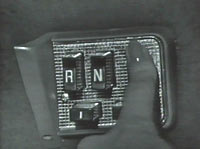
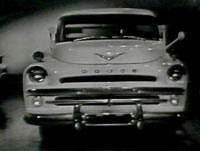
To accent the high-tech nature of the push button 1957 Swept-Wing Dodge, the car is compared with the latest in TV technology, offering us an opportunity to view a 1957 television camera close up.

This car was unique because you would actually change the gears by pushing buttons on the dashboard. Available with 'Torsion-Aire Ride,' four barrel carbs and a 354 cid Hemi V8. And don't forget the 'realm of silence' ride.

57 Dodge commercial\

1957 Dodge Trucks
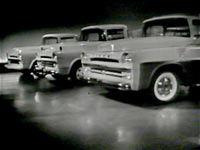
The '57 Chevy is an American icon, but the Dodge pickup that year was its poor cousin. Still, the D100 half-ton was a solidly-designed truck, available for the first time with power brakes, power steering and a push-button, three-speed automatic transmission.

Observe what Dodge called the 'Giants of the Low Priced Three.' The 'Dodge Power Giants' were available in one-ton models with a 315 cid V8 engine packing 204 horsepower. You don't see many of these trucks restored and on the road today - they were all worked to death!

1957 Dodge Truck adDodge truck ads 1950s

1957 Plymouth Sport Suburban
Fly the new Suburban - the latest in space-age design with fold-down rear seats and a back window that goes up and down with the flick of a switch. This ad used airplanes as a metaphor for the family car, a common theme in auto advertising. After all, this was the 'Jet Age.'


1958 Fords
A handful of celebrities gathered on a soundstage in 1957 to endorse this line of new Ford tank-like vehicles.

The announcer was future 20/20 host Hugh Downs, look for Arthur Godfrey, Dick Powell and Tennessee Ernie Ford (all popular on TV at the time) in this fall commercial than runs for over three minutes.

(With the 1956 models, the Ford Motor Company began to take passenger safety seriously with the introduction of padded instrument panels, sturdier steering wheels and seat belts. In spite of this, there was tremendous resistance on the part of consumers to using those seat belts.)

1958 Dodge
The American automakers really knew how to design cars in the fifties - and they got pretty sophisticated at selling them on television as well. That's because they had a lot of money to spend!

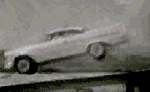
Dodge shot one of their 1958 model cars out of a cannon to prove their 'Swept-Wing' autos were sturdy enough to take the punishment. Heck, they designed the damn things like a bullet anyway!
They even stripped the car down to the chassis and shot it out of the cannon again to demonstrate durability. If you ever longed to see a '58 Dodge dissected to the skeleton and rolling down the road, this is the commercial for you!

1958 Dodgecar commercials

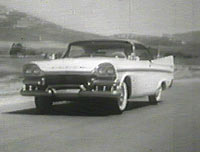
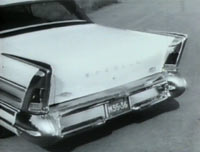
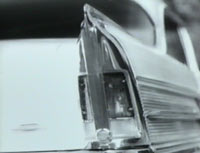
1958 Buick
The '58 Buick had a lot of chrome and this spot gives you tight closeups of the remarkable metal work that adorned these 3,000 pound behemoths.

Cars with fins were on the way out by 1958 - Buick was lucky, they had the more subtle versions.The 'Airborne' B58 Buick was equipped with a B12000 engine and Dyna-Flow transmission.

1958 Buickcar commercials

\\

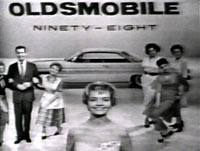
1961 Oldsmobiles
This is a prime example of a style of advertising that was popular decades ago, the big musical production number.

In this spot, ladies and gents dance and sing around the new Super 88, Dynamic 88, and Ninety-Eight luxury cars - a Rocket V-8 powered vehicle redesigned to be sleaker than the bulky designs earlier in the decade.

Look for pre-Brady Bunch mom Florence Henderson singing and dancing in this spot. She went from advertising cruise control to ooze control - Florence Henderson is now the spokesperson for Polident.

The Olds 88 was renamed Delta 88 in 1965.

auto ads

1959 Chevrolet
In the expanding boom economy of the late fifties, television changed the face of advertising forever. Magazine readers and radio listeners were used to celebrity endorsements but with television you could actually see and hear your favorite star interacting with the sponsor's product in your own home - for the first time.

Pop star Dinah Shore starred in this exciting, elaborate presentation that was flawlessly executed; everyone looks great, the music is snappy and even the helicopter lands on cue; a fine example of old-school 'bigger-is-better' advertising dynamics at work.

This kind of big production number-style advertising came back in style briefly (and better than ever) in ads for Mountain Dew, Old Navy and The Gap in 2000 - but in the case of The Gap, it was a resounding sales failure.

These commercials were also subtle social cues as to which cars were meant for women or men.

59 chevy1959 Chevrolet

1970 Plymouths
'Those Daring Young Meg In Their Flying Machines' was Plymouth's slogan for their failed attempt at marketing their fading, bloated (but stylish) 1970 muscle car line. 

If you're a fan of the '70 Barracuda or the GTX convertible, you'll love the shot of these large, lurking monsters roaring down the road. 

This was the last grasp for a proud line of hot cars. Muscle cars were massive in bulk and way too heavy by 1970, averaging a mere 8 miles a gallon. 

That had never been a problem with plentiful gas stocks, but the gasoline price hikes and oil embargoes of the early-seventies put all of Plymouth's muscle cars out to pasture by mid-decade.


1966 Mustang 
"Should a single girl buy a 1966 Mustang?" That's the burning question posed here. Success and marriage are right around the corner if you do, at least according to the fine folks at Ford.


The Ford Mustang introduced a new era in car making and merchandising - an affordable, sporty, small (by 60's standards), well-designed automobile marketed primarily to women. Enough men bought the Mustang that Ford repositioned it as a musle-car a few years later.


http://www.tvparty.com/vaultcomm.html

Tuesday, 27 May 2014

The 2014 Ford Escape Campaign focuses on Foot-Activated Liftgate


The 2014 Ford Escape ad campaign addresses the common hand-cuffed feeling drivers have when putting objects into the trunk of their car. When it comes to items such as fragile vases, unwieldy carpets and heavy crates, opening that back door can prove to be incredibly tricky. That is why this ad campaign focuses on the vehicle's foot-activated liftgate feature.

Conceived and executed by the Young & Rubicam ad agency branch based in Toronto, Canada, the 2014 Ford Escape ad campaign brings attention to a practical feature that could easily sway a person's decision when car-shopping over a sunny weekend. It was art directed by Mike Lo Nam with creative direction by Jonathan Smith. The images were shot by Adrian Armstrong and retouched by Adrian Armstron.

2014 Ford Escape

2014 Ford Escape
2014 Ford Escape

Friday, 9 May 2014

GM, Ford, Toyota join UM in establishing driverless car test site in Ann Arbor

By 


Monday, 5 May 2014

Australia's Automotive Industry is Set to Boom, says New Report

Future of the auto industry ... Adam Fry has started an apprenticeship at Mike Carney Toy
Future of the auto industry ... Adam Fry has started an apprenticeship at Mike Carney Toyota. Picture: Fiona HardingSource: News Limited
THE closure of car manufacturing plants will not kill Australia’s auto industry, according to a new report from Auto Sills Australia.
The industry is instead predicted to grow as the research reveals a national shortage of 21,175 workers in key skills areas of the car industry.
Light vehicle mechanics and panel beaters account for more than 50 per cent of the shortage and as the number of cars owned by Australians grow more than 400,000 each year, they will continue to be in high demand.
“Our report shows that employment gains within car and parts wholesaling, repair and maintenance and tyre retailing has more than compensated for declines in employment within car and component manufacturing,” says Mr Geoff Gwilym, CEO of Auto Skills Australia.
“Even before the announcement of the car manufacturer closures, the retail, service and repairs sector comprised 87 per cent of Australia’s automotive industry,” Mr Gwilym said.
“So while manufacturing is facing tough times, retail, services and repairs represents the biggest part of the industry and it’s searching for workers to maintain the nation’s growing vehicle fleet.”
Call to young ... there are millionaire mechanics out there. Picture: Thinkstock
Call to young ... there are millionaire mechanics out there. Picture: Thinkstock Source: Supplied
For those who have lost jobs, Mr Gwilym said the expected growth in caravan manufacturing may see jobs available for Ford, Holden and Toyota workers. But upskilling is another possibility.
Phillip Murphy, from automotive training at Kangan Institute, said he is already seeing manufacturing workers being re-skilled to take up new jobs in areas of high demand.
“A number are currently being retrained in the automotive and engineering industries,” he said.
“Their skills can be transferable across multiple sectors.”
And with high demand for workers, both men are also keen to see more younger Australians entering the industry.
“Parents prefer their kids to have a white collar job, but there are millionaire mechanics out there,” said Mr Murphy.
“The focus for higher education has been on university,” Mr Gwilym said.
“But trades should be considered a viable option to help the country build its domestic skills.”

Wednesday, 23 April 2014

FORD KUGA: NO HANDS. NO WORRIES

Ford Kuga: Train
Mexican, Ford Kuga, JANDL Bratislava , Ford, Print, Outdoor, Ads
Ford Kuga: Shark

Cute play on Graphics with this latest print campaign for the new Ford Kuga, with foot-activated tailgate technology. 

http://adsoftheworld.com/media/print/ford_kuga_train

Friday, 4 April 2014

Classic Lincoln Advertising As Art

By  |   |  Nothing Could Be Finer


Drawn Quarters
As a practical means of communication, photography is about as old as the automobile. But into the 1950s, automakers predominantly entrusted artists to idealize their products in advertising. Lincoln's first all-new postwar design for 1949 (see ad below) drew criticism because the cars were difficult to distinguish from the Mercurys with which they shared architecture, so the advertising art renders the smaller, sleeker cars to look longer and lower, backing up the theme "Nothing could be finer...or Newer!"


Race ReadyAnother downsizing for 1952 had Lincoln taking aim not at Cadillac, but at Oldsmobile, with models “powered to leave the past far behind.” The emphasis shifted from poshness to performance, as evidenced by the reference to four wins in the Mexican Pan-American Road Race. By 1953, when this Capri coupe was shot, Julia Meade was just starting her decade as the voice and face of Lincoln on Ed Sullivan’s wildly popular “Toast of the Town” TV show. 

Embryonic Fins

In the ‘50s, styling tricks were selling cars, and the tailfin, which got its start on the ‘48 Cadillac, was chief among them. This shot lets us take the full measure of Lincoln’s finlet, while the profile view emphasizes the “tasteful use of chrome.” Lincoln’s minimal ornamentation earned the mid-century “modern living” tagline, while racing successes warranted the “magnificent driving” line. But Lincoln never managed to out-macho Oldsmobile, so it stopped trying and marched back upscale for 1956.

Mixed Messages

Lincoln’s agency of record from 1948 to 1979 was Kenyon & Eckhardt, of Madison Avenue. Its “Mad Men” drew praise for the ‘55 campaign’s confident, eye-catching photography, but also criticism for the campaign’s lack of a consistent, coherent theme. Disparate ads stressed performance, refined elegance, or the pursuit of an active lifestyle. The unfocused campaign mirrored an internal struggle over which way to take the brand. Luckily, longer, lower, and wider would win the day. 

Trick Photography


At about the time this 1958 Premiere Landau was shot, Detroit’s Boulevard Photographic studio had devised a curved film holder that effectively stretched a car in the camera to appear longer and lower, providing the car was dead level with the camera. (Otherwise the car could appear bent, like a banana.) BP used the curved film holder for a few years before switching to an anamorphic lens that distorted the image by optical means, rather like a CinemaScope movie camera lens. 


Luxury Redefined

After years of hollow hyperbole about the trendsetting design of the ‘57-’60 models, the ‘61-’69 Continental truly delivered it: Elegance, minimal ornamentation, and “suicide” rear doors.Early ads described it as “a new kind of fine car,” and in a reversal of the perennial “longer, lower” lingo, ads now boasted “greater luxury with 14 inches less length.” Lincoln’s industry-leading 2/24 warranty also figured prominently in ad copy, in an effort to repair a tarnished reputation for build quality. 

All Access


In a rare return to illustration, this spare image depicts what other ads spelled out: “Four doors mean you walk into the rear seat...instead of climbing around the front seat.” The Continental was indeed America’s first and only four-door convertible since the demise of the short-lived ‘49-’50 Kaiser Deluxe. As the copy alludes, this ‘63 model’s $6916 base price would buy two loaded Ford Galaxie 500 Sunliners, but the Fords would certainly be worth way less than the Lincoln three years later. 


Neoclassic


Photographer Mickey McGuire was directed to find “a smug, middle-aged, bald guy with a bad attitude” for this moody 1968 Continental Mark III ad, according to “Boulevard Photographic: The Art of Automobile Advertising.” The guy had plenty to be smug about when piloting this new personal luxury coupe, which was conceived to reclaim some of the original Continental Mk II’s exclusivity. Priced at $6585, it cost $615 more than the four-door Conti, but still undercut the 1956 original by more than $3000.

Tuesday, 1 April 2014

Ford kick-starts pan-European campaign for connected car EcoSport with exclusive Facebook presale

POSTED BY 


Ford has kicked off the digital campaign for its connected car model EcoSport at Mobile World Congress in Barcelona by making 1,000 cars available exclusively via Facebook ahead of the official rollout in May.
Customers across 11 European countries including the UK, can from today configure and reserve one of the connected car models via the social network. Around 100 cars will be made available per country.
The cars that are made available in the pre-launch sale will also feature two additional connected apps for free - a parking app created by developer Parkopedia, and a voice-controlled personal radio app, which use Ford’s open-source AppLink technology among other mobile apps including Spotify.
The partnership with the two app developers was also revealed in Barcelona today, with Parkopedia providing drivers with the ability to search for 15 million spaces across Europe, while Aupeao’s app will let them voice control their favourite music from more than 200 curated radio stations.
The Facebook sale marks the start of Ford’s ‘EcoSportLive!’ campaign, the digital part of which will launch officially tonight in Barcelona with a free YouTube concert featuring 10 emerging artists including Natalie McCool, Mickael Miro and Nina Zilli.
The event, which will be hosted by TV and radio presenter Sarah-Jane Crawford, will also be broadcast live on Spotify and live streamed through Ford’s European YouTube channel.
The Ford EcoSport SUV is among the first vehicles in Europe to offer AppLink, which already incorporates mobile apps such as Spotify.
Speaking to The Drum at Mobile World Congress Ford’s connected services director for Europe Duncan Burrell, said the car maker is continuously looking to extend and evolve its app ecosystem, and will be rolling out AppLink to all its car models.
He said experiments are already underway to test new forms of mobile apps, particularly around driving behaviour and insurance.
“You get apps now on smartphones that help characterise how you are as a driver. In insurance there was a time a few years ago when you could classify someone by sex and age and various profiles – but in Europe they are not allowed to do that anymore – they have to offer more open policies and not discriminate. So there is a move to behavioural based-type insurance.
“We are not ready to launch anything like that but we are looking into proofs of concept and what we can do around monitoring your behaviour – all consent based. It is stuff we are discussing now for future possibilities.
However, he said for this industry and for smart-car app developers to achieve the volume they need to have a sustainable business model and to combat the fragmentation in the mobile market car makers must work together. “That’s why we have made AppLink open source, so any car maker can use it. We don’t mind if competitors use it because it’s not about the fact that they do it it’s about how well they do it.
“Apple in the beginning wasn’t offering anything hugely different to other smartphone makers but it was the design and experience of it that stood it apart,” he said.
Ford previously revealed plans to loan 100 new Ford EcoSport SUVs for up to six months to music, fashion, food and sport bloggers from Austria, Belgium, France, Germany, Ireland, Italy, the Netherlands, Spain, Switzerland, and the U.K. The bloggers will test Ford SYNC with AppLink and share their experiences of the car on social media.

Thursday, 27 March 2014

Ford Mustang Celebrates 50 Years, Revisits The Empire State Building


Ford’s iconic Mustang muscle car is about to celebrate its 50th birthday, andFord has a special treat in store to mark the occasion.
The original Mustang may have raised eyebrows for its styling, but it raised a few more when it was perched on the Empire State Building’s 86th floor observatory at its official launch in 1964.
The all-new 2015 Mustang is about to replicate that feat, with one of the ‘pony cars’ painstakingly cut into pieces so it can be transported to the 86th floor by elevator.
Upon arrival, the engineers will have just six hours to reassemble the pieces until the complete Mustang is once again parked in the same place as its predecessor from 50 years ago.
The elevator is the only viable option to transport a car to the Building’s 86th floor; no portable crane can reach that high, and helicopter delivery is impossible due to the narrow deck.
The original Mustang was cut into three pieces, with the windscreen transported separately. As the new model is around 18cm longer and 10cm wider than the ’64 model, the task will be even more difficult second time around.
The Ford Mustang was revealed to the world with a television advertising campaign on the evening of April 16, 1964, before being shown to the public at the New York World’s Fair on April 17.
Visitors to the Empire State Building around these dates in 2014 will have just 54 hours to see the Mustang before the removal process begins.
“New York is one of the greatest cities in the world, and it’s the place where the Ford Mustang story began 50 years ago,” Ford chief operating officer, Mark Fields, said.
“We’re thrilled to be visiting the architectural landmark that has been the heart of the Manhattan skyline for 83 years with the newest generation of the car that is the soul of Ford Motor Company.”
Ford US dealers recorded 22,000 sales and orders for the Mustang on its first day, with 418,000 sales chalked-up in the first year, and one million North American sales in less than two years.
To date, the Ford Mustang has sold more than nine million units in the last 50 years.