Showing posts with label South Africa. Show all posts

Thursday, 12 September 2013

Audi South Africa: #AudiA3Exchange


In the first half of 2013, an 18-wheeler truck drove across South Africa, guided by the tweets of hopeful South Africans. Inside the truck: a new Audi A3 Sportback. Outside: a social media frenzy. The Idea: Audi A3 Exchange. An opportunity for people to exchange their own car for the new Audi A3 that was inside the truck.
The campaign launched with TV, radio, online and the truck itself, all sending people to our microsite or mobi-site. Here people could enter, choose their Exchange City and monitor the truckâs progress in real time. Agency: Ogilvy & Mather Cape Town

After 3 weeks, more than 50 000 tweets guided the Exchange Truck to its final destination â Joâburg. Three finalists were put through a series of challenges. Each challenge was designed to demonstrate a feature of the new A3. The finalist who completed all four challenges in the fastest time got to exchange their car for the new Audi A3 Sportback.

Over the 3 week campaign period, 11 310 people entered to exchange their own car. The campaign generated over 50 437 tweets and Audi South Africa was trending on Twitter within 5 hours of the campaign going live. Audi South Africa increased their Twitter following by 68% in 3 weeks and generated R3 116 654 worth of earned media. And, most importantly, the interest in the A3 Sportback on the Audi website tripled, resulting in more than 100 real life test drives per week.


Wednesday, 17 April 2013

Tuesday, 5 March 2013

Volkswagen Street Quest - South Africa

A very fun and seriously engaging social media activation to kickstart Volkswagen's Facebook page in South Africa.


Read more on CreativeSandbox.

Friday, 7 December 2012

Choose Your Own Soccer Team for a Match to the Death in South Africa via Mobile


Read the Case Study in Google's Creative Sandbox.

Thursday, 22 November 2012


No SA build for ‘bad quality’ Inyathi

22 November 2012


A Chinese state-owned company is cancelling plans to manufacture Inyathi minibuses in South Africa after facing hostility from the taxi industry, Business Day reported on Wednesday.

Resistance from the industry on Monday forced BAW SA to cancel plans to assemble minibuses locally, the company's head of sales and marketing, John Jessup, was quoted as saying.

“STOP BUYING IT”

The taxi industry cited quality concerns and threatened to stop buying the Inyathi. SA National Taxi Council chief executive Nkuleleko Buthelezi said they told their members not to buy the vehicles.

“We told our members not to buy that taxi until we have guaranteed the quality of the product,” he told the paper.

On November 13, Economic Development Minister Ebrahim Patel opened the first phase of the taxi-manufacturing company's plant in Springs in Ekurhuleni.
 
IOL mot nov21 baw

An Inyathi taxi is picture on the line at the official launch of the new BAW plant in Springs.

Friday, 9 November 2012

VW Touareg BlueMotion: Line Drawing Print Campaign


VW BlueMotion technologies are all about making a difference and having less ecological impact. This magazine print ad from Ogilvy & Mather Cape Town for the Touareg BlueMotion proves that point by using 85% less ink - making it not as harmful on the environment. A simple creative, but would it be lost amongst the clutter?


Friday, 2 November 2012


Experts upbeat on SA auto sector


South Africa's motor industry is under pressure from the high cost of fuel, the unfavourable exchange rate, labour unrest and the potential for political instability - but forecasts for sales growth are still positive.

This emerged from the Future Group's automotive panel discussion on Thursday, chaired by TV personality Jeremy Maggs, with panellists Brian Smith of Renault South Africa, Derik Scorer, chairman of the National Automobile Dealers' Association, Keith Watson (Standard Bank Vehicle and Asset Finance) and Roland Reid, marketing director for Jaguar Land Rover SA.

To the first question - whether or not South Africa's vehicles were over-priced - the panel replied that car prices had actually fallen when compared to the country's inflation rate over the past four years.

Which neatly sidestepped the actual question, which was why it was possible to build a car in South Africa, ship it overseas and sell it for less than the retail price in South Africa.

COST OF OWNERSHIP

But Scorer added: “With interest rates moving down as they have over the past three years, and the introduction of the National Credit Act in 2007, customers can look forward to the actual cost of ownership being considerably reduced.”

Scorer also noted that the industry's major players, both importers and manufacturers, had made significant efforts to include service and maintenance plans as part of new car deals, upping value.

When challenged that even budget vehicles were unaffordable to the common South African, Reid pointed out that the common South African had neither a job nor an education, so any discussion about the automotive industry involved only that fraction of the population able to finance vehicles.

He conceded that affordability was always a key issue, but insisted that aspiration was by far the dominant factor in purchasing decisions.

“Fewer people at the top end of the market finance their vehicles.”

“These are people with disposable income who can just write a cheque,” he said.

Scorer chipped in that during August 2012, Porsche had sold 261 vehicles through its three South African dealerships - mostly expensive Cayenne models, not the cheaper Boxster.

Similarly, Smith pointed out that 60 percent of Renault Sandero sales in South Africa of the most expensive derivative, the Sandero Stepway, underlining the importance of aspiration, even at the budget end of the market.

In response to a question from the floor regarding vehicle leases, a particular aspect of South African car culture came to the fore.

“A typical customer has an obsession with ownership,” Smith said: “They believe they'll make money when it comes to re-selling the car.”

Reid agreed that to change this perception would take time. The only scenario in which South Africans were receptive to vehicle leasing, he said, was when shopping for company cars with their car allowance.

SOME COSTS BEYOND INDUSTRY CONTROL

Extraneous cost-of-ownership problems included the fuel price, the fluctuating exchange rate and the looming possibility of e-tolling, although panellists agreed that the fuel-levy approach of the Opposition to Urban Tolling Alliance had their support.

Reid said that although South Africans were becoming increasingly eco-conscious, price was still the primary concern in a vehicle purchase.

“Alternative-fuel vehicles are still too expensive.”

Watson said that in his experience buying decisions were purely aspirational, with vehicles' carbon emissions having no impact at all.

The panel agreed that the government's 'green tax' - based on the amount of CO2 emissions a vehicle produced - had little effect on purchasing behaviour. Scorer said incentives for customers to buy low-emissions vehicles would be more effective than further punitive taxes.

Electric vehicles, he added, got a lot of international focus, but he insisted their popularity would remain low in South Africa given the size of the country and the cost of the recharging infrastructure, although he speculated that extended-range such as the Chevrolet Volt could find a limited market.

Nevertheless the panel agreed that the future looked bright for the South African automotive industry. Scorer predicted 10 percent growth in 2012 compared to 211, while Watson forecast 5-8 percent growth in 2013, despite the risks posed by the oil price and possible political instability following the ANC conference in Mangaung.

Thursday, 18 October 2012

Volkswagen Street Quest Online Interactive in South Africa

Published in BestAds on October 10th, 2012.

Volkswagen Street Quest is an online game from Ogilvy & Mather Cape Town that combines Google Street View technology and the sociability of Facebook. The aim of the game is for players to find and pin as many Volkswagens on the streets of South Africa as possible.


Friday, 12 October 2012


Consumers taking much longer to pay off their cars – TransUnion


The average time taken by South African consumers to settle their vehicle finance contracts has almost doubled over the past five years, according to TransUnion Auto Information Solutions.
Prior to the implementation of the National Credit Act in 2007, the average time taken to settle a new vehicle finance contract was 25 months; it is now 43 months.

However, TransUnion Auto Information Solutions CEO Mike von Höne said there were indications that this trend was starting to improve as consumers begin to regain better control of their financial situation and strive to pay down their debts in the current low interest rate environment.

"Nevertheless, consumers continue to enter into longer period contracts, presumably in an attempt to make monthly repayments more affordable from a cash flow perspective," Von Höne added.

At present, TransUnion's data reveals that the average contract term for new vehicles is 64 months and 62 months for used cars.

TransUnion's data also reveals a slightly decreasing trend over the past year in the number of contracts that go beyond the 72-month mark.


"Contract periods that go beyond 72 months may be due to accounts that go into debt review which then allows for credit agreements to be extended. In addition, most banks may prefer agreeing to extended payment arrangements than having to repossess vehicles," Von Höne said.

The greatest portion of new vehicle contracts (51%) now fall into the 60- to 72-month bracket.

In the used car sector, approximately 36% of contracts written are for periods of between 60 and 72 months, followed by 32% for 48 - 60 months.

Go to www.transunion.co.zaor www.mytransunion.co.zafor more information

Thursday, 11 October 2012

Consumers taking much longer to pay off their cars - TransUnion

Based on article from bizcommunity.com/October 2012

The average time taken by South African consumers to settle their vehicle finance contracts has almost doubled over the past five years, according to TransUnion Auto Information Solutions.
Prior to the implementation of the National Credit Act in 2007, the average time taken to settle a new vehicle finance contract was 25 months; it is now 43 months.

However, TransUnion Auto Information Solutions CEO Mike von Höne said there were indications that this trend was starting to improve as consumers begin to regain better control of their financial situation and strive to pay down their debts in the current low interest rate environment.

"Nevertheless, consumers continue to enter into longer period contracts, presumably in an attempt to make monthly repayments more affordable from a cash flow perspective," Von Höne added.

At present, TransUnion's data reveals that the average contract term for new vehicles is 64 months and 62 months for used cars.

TransUnion's data also reveals a slightly decreasing trend over the past year in the number of contracts that go beyond the 72-month mark.

"Contract periods that go beyond 72 months may be due to accounts that go into debt review which then allows for credit agreements to be extended. In addition, most banks may prefer agreeing to extended payment arrangements than having to repossess vehicles," Von Höne said.

The greatest portion of new vehicle contracts (51%) now fall into the 60- to 72-month bracket.

In the used car sector, approximately 36% of contracts written are for periods of between 60 and 72 months, followed by 32% for 48 - 60 months.

Saturday, 29 September 2012


SOUTH AFRICA: INTERNET 2% OF GDP

By World Wide Worx published on May 29, 2012.


The contribution of the internet to the South African economy has not been measured until recently, it has been found that the internet already stands at 2% of the South African GDP and is an important enabling tool for businesses. Given that agriculture stands at 2.2% of GDP, this percentage is quite significant.


The largest contributor of investments to infrastructures are surprisingly enough, not by service providers. Though the mobile networks and fibre providers have certainly spent their fair share on infrastructure – a total of R13.5-billion – this pales beside the R29.2-billion spent on Internet presence and access.

The study further indicates that e-commerce is growing at a rate of around 30% a year, and is showing no signs of slowing down. In fact, taking into account the fact that a number of major consumer brands and chains have not yet devised comprehensive online retail strategies, the scope for future growth is even greater.

Friday, 21 September 2012

TOYOTA ETIOS TWEET FOR SWEETS

By The Nation published on April 2, 2012.


When Toyota's Etios launched in SA, it promised to make people smile. The Tweets for Sweets installation, created by HelloComputer & ThingKing, did just that by rewarding virtual smile tweets with real-life candy.

See video here: http://www.bestadsontv.com/ad/47446/Toyota-Etios-Tweet-For-Sweets

Not entirely sure how this links to the Etios in terms of a strategy campaign, but nonetheless it is an example to look at in terms of leveraging the twitter hashtag to execute an ad that is truly interactive on an experiential level.
Toyota Australian Football League (AFL) & Volkswagen South Africa Print Ad

TOYOTA AUSTRALIA


http://www.bestadsontv.com/ad/47511/Toyota-AFL-goalposts

VOLKSWAGEN SOUTH AFRICA


 http://www.bestadsontv.com/ad/47577/Volkswagen-VW-Crossfox-Giraffe

Wednesday, 19 September 2012


MOBILE ENABLES INTERNET SPREAD TO MASSES IN SOUTH AFRICA

By World Wide Worx published on May 10, 2012.


The number of Internet users in South Africa accelerated dramatically in the past year, thanks to the impact of both smartphones and ordinary mobile phones. South African Internet user base had grown from 6,8-million in 2010 to 8,5-million at the end of 2011 – no less than 25% growth. World Wide Worx also forecast that this strong growth would continue during 2012, and the Internet user base would pass the 10-million mark by the end of the year.


The headline findings revealed that a total of 7,9-million South Africans access the Internet on their cell phones. Of these, 2,48-million access it only on their cellphones, and do not have access on the computers. The remaining 6,02-million users access the Internet on computers, laptops, and tablet computers. However, 90% of this number – 5,42-million – also access it on their cellphones. This means that almost 8-million South Africans sometimes or regularly access the Internet on their phones.

While smartphones are the main driver of Internet growth, the cost of data use is being driven down by the proliferation of undersea cables connecting sub-Saharan Africa. The study shows that undersea cable capacity to South Africa at the end of 2011 was 2,69 Terabits per second (Tbps), and due to rise to 11,9Tbps by the end of 2012.

Friday, 7 September 2012

SOUTH AFRICA: VOLKSWAGEN BLUEMOTION PRINT AD HELPS CONSUMERS RECYCLE MAGAZINES

Thursday, 6 September 2012


SOUTH AFRICA: MOBILE DATA SPENDING ON THE RISE; VOICE DECLINES

By World Wide Worx published on July 25, 2012.


Proportion of the average user’s cellphone spend on data has increased by half in the past 18 months – from 8% of budget at the end of 2010 to 12% in mid-2012. Spending on voice has dropped from 77% to 73% in the same period – precisely matching the difference in data spend. Meanwhile, SMS spend remains steady at 12%, and full music tracks feature for the first time – taking up 1% of the average spend on a cellphone.


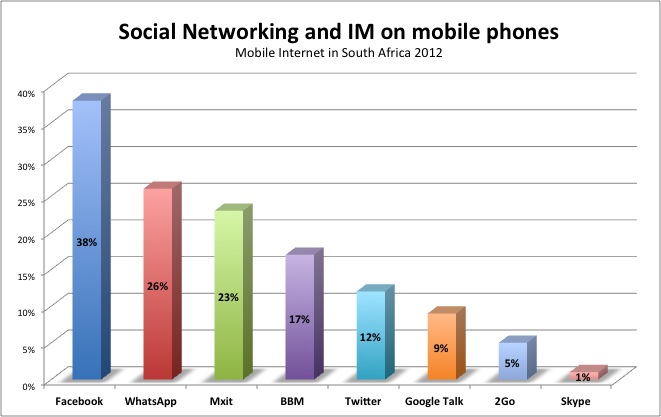
The biggest increases in specific uses of data on the phone were seen in instant messaging services, with more than a fivefold increase in the proportion of BBM users in the past 18 months – from 3% to 17% of adult cellphone users living in cities and towns – and WhatsApp emerging from nowhere to claim a quarter of adult cellphone users.

Browsing on the phone also increased substantially, from 33% to 41% of users, app downloads rose from 13% of users to 24%, while Facebook use rose by more than half, from 22% to 38%.