Showing posts with label Industry News. Show all posts

Wednesday, 5 November 2014

Study: Buick, Chevy See Increase in Consumer Satisfaction GM ads helped 


While overall consumer automobile satisfaction dropped for a second straight year, two brands saw an increase: General Motor’s Buick and Chevrolet. The findings come from the American Customer Satisfaction Index (ACSI), which said declining customer satisfaction showed scores for automobiles and light vehicles falling 1.2 percent to 82 on a 100-point scale.
The only cars to improve were Chevrolet, with a 4 percent increase, and Buick, with an increase of 1 percent, bringing both U.S. brands up to the industry average of 82.
ACSI found that 16 of 21 brands they track saw declines in overall satisfaction ratings, with imports faring only slightly better than domestic vehicles.
As the only U.S. brands to see an increase, Buick and Chevrolet saw improvement in large part because of GM’s advertising push for those models—despite the active recalls the company is experiencing. (In fact, ACSI found that consumers who had a recalled vehicle overall rated their brand 6 percent lower than consumers of the same brand who did not experience a recall.)
“A considerable investment in Buick appears to be paying off for General Motors,” noted the report. “Sales are up 12.5 percent for the first half of the year—the largest increase for any GM car—led by a surge in sales for Buick Encore.”
Mercedes-Benz saw its ranking drop 2 percent, but, according to ACSI, the brand still has the highest overall score of 86. Subaru dropped 1 percent to a score of 85; Lexus fell 3 percent to match Volkswagen’s unchanged score of 84; and Toyota and Honda each slipped 3 percent to 83. Other changes include Ford, Nissan, Hyundai and Chrysler all coming in with a score of 81; Cadillac dropping a full 6 percent in satisfaction to a score of 80; and the Jeep and Dodge brands ranking last among all brands at 79 and 78, respectively.
“There are two aspects of these findings that are somewhat unusual,” Claes Fornell, ACSI chairman and founder, said in a statement. “The first is that although the domestic car industry has deteriorated in customer satisfaction over the past couple of years, the gap to imports has narrowed due to a weakening of the latter’s customer satisfaction. The other notable finding is that several of the luxury brands do poorly. That didn’t use to be the case, and suggests that consumers now expect more for their money when they pay a premium price.”
To compile the report, ACSI interviewed 4,360 consumers, chosen at random, via telephone and email between April 22 and May 29, 2014. Consumers were asked to evaluate their recent purchases, as well as talk about their experiences with automobiles manufactured by the companies the study tracks. The group follows a wide range of consumer product categories and releases reports detailing each one throughout the year. Automobiles and light vehicles rank sixth overall in consumer satisfaction, according to their statistics.

Friday, 25 July 2014

Toyota Launches "Dream Car of the Day," Making Kids' Artwork a Reality for the First Vine Campaign Showcasing Children around the World

Toyota will celebrate 90 finalists of the 8th Toyota Dream Car Art Contest with Vine videos, released every single day from May 29th to August 31st

PR Newswire
TOKYO, May 29, 2014 /PRNewswire/ -- Toyota Motor Sales & Marketing Corporation(TMSM), a subsidiary company of Toyota Motor Corporation (TMC) today announced the launch of "Dream Car of the Day," a first-of-its-kind Vine campaign that brings an exciting new dimension to its annual Toyota Dream Car Art Contest. For the first time in the history of the contest, TMSM is sharing the inspiring works of 90 finalists with an online campaign using Vine, one of the hottest mobile apps that enables users to create and post six-second short looping video clips. The online campaign reflects the global scale of the contest, allowing for worldwide exposure to the impressive ideas of children, and aligns with the company's guiding philosophy of innovation through next generation thinking. 
Believing that the children who dream and develop their imagination create the future, TMSM hosts the Toyota Dream Car Art Contest each year and asks kids to draw their dream car of the future. The 2014 8th Annual Toyota Dream Car Art Contest attracted more than 660,000 submissions from over 75 countries and regions worldwide.
In order to show how powerful kids' imaginations can be, TMSM partnered with creative agency Saatchi & Saatchi Fallon Tokyo to conceptualize the Dream Car of the Day and bring the 90 finalists' dream car drawings to life through 3D and 2D animations. Each design will be featured in its own Vine video, taking viewers on a ride through the imagination of the young artist.
Starting today, and for the next 90 days, one new artwork and accompanying Vine video will be revealed on the Dream Car of the Day website and on social media. Visitors can view the Vine video by "liking" it. The Dream Car of the Day website will be home to all 90 dream car designs and will feature each child as the "hero" for the day, collectively serving as an inspiring representation of the creativity of the world's future innovators.
Key Highlights:
  • The Toyota Dream Car Art Contest started in 2004 and is one of the largest global art contests for children with the 8th annual contest attracting over 660,000 participants from over 75 countries and regions around the world
  • Many of the submitted works of art show a strong theme of sustainability messages with car designs offering imaginative solutions to large-scale social and environmental issues
  • Winning artwork were selected by a panel of external and internal judges, including illustrators, designers and the President of Toyota
  • 2014 marks the first year that Toyota is showcasing the contest online through a first-of-its-kind Vine campaign
  • Dream Car of the Day campaign will celebrate the 90 finalists selected from the winners of regionally held Local Contests who have been entered into the World Contest, where they are judged to qualify for the final awards
View the mini artwork here

Thursday, 24 July 2014

GM Is Moving Deeper Into ‘Next Frontier’ of Virtualization


General Motors Co.GM -0.87% is joining the ranks of large companies that are replacing traditional hardware such as storage and networking gear with software, a process known as virtualization.
Like most companies, GM began to virtualize mainframes and servers years ago, and that process is more or less complete. Now, having seen the economic and operational benefits of that process, GM is moving to virtualize other elements of its IT infrastructure, according to Jeff Liedel, executive director of the company’s global IT operations. He is based at the company’s $130 million data center in Warren, Mich.,which was modeled on IT infrastructure developed by Internet companies such as Facebook Inc. and Google Inc. The data center project was overseen by CIO Randy Mott.
“Virtualization brings a lot of benefits,” Mr. Liedel told CIO Journal. The virtualization of the server market paved the way for the spread of many kinds of cloud computing over the last few years, because it facilitated the sharing of hardware by multiple users. He expects that the expansion of virtualization into new areas of IT will have a significant impact, too.
“From a cost perspective, virtualization allows us to better leverage the hardware that we have across a variety of domains. We see the utilization of capital go up, and that is a good thing for any company.”
Virtualization allows companies to run software on lower-cost commodity machines. Assuming a certain degree of standardization among lower-cost gear makers, GM will be able to include hardware from a variety of vendors in its infrastructure. “We will be able to mix suppliers in a more seamless fashion. Virtualization allows you to have a multi-vendor environment and be less reliant on proprietary tools,” Mr. Liedel said.
GM has virtualized about 80% of its servers. As Mr. Liedel said, the company always will have a need for some servers that are linked to specific applications, so the level will never reach 100%. Virtualization of storage is in the early stages, and is only about 10% to 20% complete. Network virtualization is in the exploratory stages, but promises benefits such as dashboards that make it easier and faster to configure the network. “Software-based management tools make it easy to reallocate storage of networking capacity. You don’t have to physically recable something,” Mr. Liedel said.
Further into the future, he expects more applications to be virtualized.  Years ago, all applications had their own logon or password components. “Other functions and applications can be virtualized,” Mr. Liedel said. “I think that is the next frontier.”

Thursday, 17 July 2014

By Hilary Weaver on May 21, 2014 in Innovation 
Paralyzed Racer Drives Corvette With Head Movements
How infrared technology can help people with disabilities regain mobility.

Sam Schmidt has become the official tester for leading innovations in race car design. And all he has to do is shake his head.
Before a collision in January of 2000 that left him paralyzed from the neck down, Schmidt was a driver for the 27 Indy Racing League. After his accident, the former driver wanted to help others find a love for the sport with his own racing league, Schmidt Peterson Motorsports. In late 2013, innovators at Arrow Electronics approached him about a project that would allow him to return to his space behind the wheel.
Arrow created a 2014 Corvette Stingray C7, what the tech company calls a “semi-autonomous motorcar” that allows paraplegics and quadriplegics like Schmidt to operate a vehicle around the racetrack with simple head and mouth movements.
The SAM car, which will debut at the 2014 Indianapolis 500 Festival with Schmidt as its driver, features infrared sensors and cameras that can measure the movements of the driver. Schmidt wears a hat with infrared sensors that pick up his movements.
For example, when Schmidt wants to steer his car left or right, he moves his head in that direction. Infrared cameras pick up these movements and steer the car accordingly. To accelerate, he leans his head back, and to brake, he bites down on a pressure sensor in his mouth.
Additionally, the car’s built-in GPS creates what Arrow refers to as a virtual curb and warns the driver when the car edges one meter away. If the driver makes an error, an engineer is immediately notified and can remotely control the car.
Arrow says that these innovations are not specific to race cars and can one day be applied to consumer vehicles.
Source: Wired

Thursday, 10 July 2014

Glory! Glory! Manchester United finally march out with new Chevrolet strips and the fans cheer them on


With cheering fans marching on , one of the most controversial  sports sponsorship deals ever - General Motors backing Manchester United - was finally  turned into an advertising reality yesterday.
In a video showing off   Chevrolet's "Bowtie" logo, the US car giant  finally took over from  AON as United's match-shirt sponsor. The video  does it brilliantly, telling the story of United's strips down the years.
The timing works well for Chevy, says the American Adage magazine .
“ With Team USA performing well at the 2014 FIFA World Cup Brazil, soccer fever is at its peak in the U.S.”
The 60-second spot by Chevy agency Commonwealth   shows club legends and supporters singing their "Glory, Glory, Man United" song as they march down to the Old Trafford stadium.
There were nine famous ex-players  in the video:  Sir Bobby Charlton, Dennis Law, Alex Stepney, Norman Whiteside, Arthur Albiston, Clayton Blackmore, Dennis Irwin, Gary Pallister and Lou Macari. How many did you spot?
Along the way, we see the fans putting on and taking off the club's previous red shirts  - until they catch up with the new one 
United’s current stars including Wayne Rooney step forward to unveil the Chevy kit. "The shirt belongs to you. Always has. Always  will,” says Rooney.
Chevy is inviting fans to sign up for an app at www.ChevroletFC.com where they can virtually try on the Chevy kit. The new campaign is part of Chevy's global "What Do You #PlayFor" marketing effort.
"Our presence on the new Manchester United home shirt is a highly anticipated moment for the club's more than 659 million followers around the globe, and for the Chevrolet brand," said Tim Mahoney, CMO of Global Chevrolet in a statement.
 "From the beginning of our partnership with Manchester United more than two years ago, we pledged to bring fans closer to the game. This celebration of the new shirt will honour that pledge by making them part of the unveiling."
 Man U. will play its first match bearing the Chevy logo during the Chevrolet Cup July 23 at the Rose Bowl in Los Angeles. Their opponents: LA Galaxy.
Joel Ewanick, who held a global CMO post similar to Mahoney, was roundly criticised  for agreeing to pay $559 million over seven years to sponsor the club known as the New York Yankees of international soccer.
He was fired  shortly after finalising the deal in 2012.  Ewanick publicly defended the deal as a "no-brainer" during an automotive conference in Las Vegas in 2013.

GM to Boost China Production Capacity to 5M

BEIJIN (AP) -- The president of General Motors said Sunday that the company and local partners are boosting production capacity for GM-brand vehicles in China to 5 million.

Speaking at the Beijing auto show, Dan Ammann said the company also expects sales of its Cadillac luxury cars to double to 100,000 next year.

General Motors Co. and its Chinese partners are in the midst of what the company has said is a $12 billion investment program through 2017.

Matt Tsien, President of GM China, said that includes three factories due to open this year and two more next year. He said they would raise the capacity for production of GM-brand vehicles in China to 5 million.

'I think the addition of the several new plans currently under construction will helps us reach the capacity of 5 million units by the end of 2015,' Tsien said. 

GM is neck and neck with Germany's Volkswagen AG to be China's most popular vehicle brand. GM said earlier that its 2013 sales rose 11. percent to 3.1 million vehicles.

Ammann said the company expects to grow at least as fast as the market this year. Forecasters expect the overall market to expand by 8 to 10 percent. That could raise GM sales to 3.4 million. 

'We are moving full speed to keep up,' said Amman. 'We count on China for another record year in 2014'.

The company plans to increase production capacity in China by 65 percent by 2020, Tsien said.

The company said it, along with local partners, will invest $12 billion in China between this year and 2017. 

GM manufactures sedans, minivans, pickup trucks in joint ventures with state-owned Shanghai Automotive Industries Co. and Liuzhou Wuling Motors CO. The three companies also launched a seperate low-cost brand, Baojun.

Friday, 4 July 2014

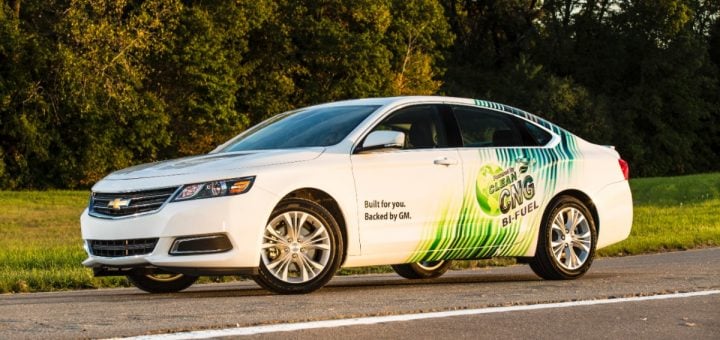
General Motors Prices out Natural Gas-Powered 2015 Chevrolet Impala

2015 Chevrolet Impala CNG

Last year, General Motors announced it would become the industry’s only manufacturer to produce a full-size sedan in North America capable of running on both compressed natural gas and gasoline with the arrival of the 2015 bi-fuel Chevrolet Impala. Now, the automaker has announced the bi-fuel Impala will go on sale in the fourth quarter of this year carrying a starting price $38,210, including an $825 destination charge.

The vehicle is available in either LS base trim or a more well-equipped LT trim and with only one powertrain option, a 3.6-liter V6 with hardened valves and valve seats for improved wear resistance to accommodate the CNG fuel system. A trunk-mounted CNG tank stores the equivalent of 7.8 gallons of gasoline, which is good for about 150 city miles of range on compressed natural gas. The total range using both CNG and regular gasoline should be able to top 500 miles, GM estimates.
The bi-fuel system in the Impala will run primarily on CNG until the fuel tank is completely depleted, at which point the system will automatically switch to run on gasoline. Drivers can also change fuels on demand via a button on the dashboard, which also indicates through an LED light when CNG is being used. GM says CNG delivers fuel savings of nearly $1.25 per-gallon and is one of the cleanest burning fuels available.

If you’re weary about the reliability of the CNG fuel system, it is covered by GM’s three-year, 36,000-mile new vehicle limited bumper-to-bumper warranty and five-year, 100,000-mile limited powertrain warranty. It will be assembled at GM’s plant in Oshawa, Ontario and will be available for purchase at more than 3,200 Chevrolet dealers beginning later this year.

Monday, 30 June 2014

GM Takes an Aggressive Step on Clean Transportation

GM - Clean Transportation

Automaker has ambitious plans when it comes to changing the face of transportation

General Motors recently announced that it has begun overhauling many of its operations in order to become more sustainable. This is a trend that is becoming increasingly common in the auto industry, especially as automakers begin to feel pressure from the world’s governments that are concerning with clean energy and emissions. Many governments are introducing new emissions standards that are specifically targeting transportation. This means that automakers are beginning to feel the need to produce environmentally friendly vehicles in order to retain their place in prominent markets around the world.

GM to restructure itself in  order to better navigate the challenges of climate change and energy security

General Motors will be restructuring its global vehicle portfolio as well as reworking its manufacturing process. The automaker will also begin working with numerous new partners in order to make use of new technology and become more environmentally friendly. General Motors notes that climate change and energy security have become major challenges for the auto industry as a whole and are no longer matters that are solely within the realm of politics and activism.

Automaker intends to transform transportation and bring 500,000 electric vehicles to the road

The automaker envisions its efforts as a way to “transform transportation.” General Motors aims to sell some 500,000 electric vehiclesby 2017 and believes that the demand for these vehicles is growing rapidly among consumers, businesses, and government agencies. The company has committed itself to reducing carbon emissions, especially in China, where air pollution has become a serious health problem.
GM will focus on battery electric as well as fuel cell vehicles in order to achieve clean transportation goals.
Currently, approximately 153,034 electric vehicles from General Motors are on the road. The demand for these vehicles has been modest in the past, but more consumers are becoming interested in clean transportation, especially as battery technology becomes more advanced and efficient. General Motors is not only interested in producing battery electrics, of course, and has plans to introduce fuel cell vehicles at some point in the relatively near future.
http://www.hydrogenfuelnews.com/gm-takes-aggressive-step-clean-transportation/8517978/

Thursday, 26 June 2014

A Simple Innovation On The 2015 GMC Canyon and Chevy Colorado Could Save A Child's Life


General Motors is making it safer for children to ride in the rear seat of its midsize pickup trucks with a simple but effective feature that debuts on the 2015 GMC Canyon and 2015 Chevrolet Colorado, set to go on sale this fall.
Typically, midsize pickups with an extended cab have a pair of truncated rear seats, because there isn’t enough room to include normal ones in the back. The trouble is, the seat cushions aren’t long enough to fully support the base of most car seats for kids, which makes them unstable and less effective at protecting these passengers in a crash.
To fix that problem, GM engineers created a way to extend the lower cushion of the rear passenger-side jump seat in the Canyon and Colorado simply by removing the head rest and reattaching it to the front of the seat cushion. (See the video below for a demonstration.)
“The additional seat cushion length provides more support to the child restraint, which helps to reduce the rotation and the risk of injury in a crash,” says Eduardo Bugelli, GM safety performance team lead. A patent on the design of the seat extender is pending.
Credit: General Motors
The 2015 GMC Canyon (Credit: General Motors)
GM says the Canyon and Colorado will be the first pickups to offer such a feature. They also will be the first midsize pickups to offer forward collision warning and lane departure warning, two advanced safety features that are part of an optional Driver Alert Package.
Given that pickups are increasingly used as everyday passenger vehicles, rather than just as work trucks, these kinds of safety features are becoming more important to buyers, who are carting kids around in them more so than in the past.
The Canyon and Colorado will come in three body styles. Only the extended cab model with a six-foot cargo bed will get the seat extender, which will come as a standard feature. Two crew cab versions, one with a five-foot and one with a six-foot bed, have full-size back seats that don’t require it.
Credit: General Motors
With the extender in place, a child seat in the rear of the 2015 GMC Canyon is more stable. (Credit: General Motors)
In contrast to the full-size truck market, which domestic automakers dominate, GM is the only American company currently producing a midsize pickup truck. Both Chrysler and Ford have ceded the market to Japanese automakers Nissan and Toyota, whose Frontier and Tacoma are top sellers.
But GM sees an opportunity: Full-size pickup owners who like having a truck and don’t make use of its rugged capabilities might be looking to downsize if it saves them money and fuel. That’s where the all-new GMC Canyon and Chevy Colorado come in.
They’re smaller and lighter than the full-size Chevy Silverado and GMC Sierra pickups, and they offer an efficient four-cylinder engine. A V6 and turbo-diesel also will be available, with the latter coming for the 2016 model year.
Though they are corporate twins, the two new midsize models target different types of buyers. The GMC Canyon, which debuted at the 2014 Detroit auto show, is meant for small-business owners and other professional users, whereas the Chevy Colorado, which debuted at the 2013 Los Angeles auto show, is geared toward outdoorsy types.
The 2015 GMC Canyon and 2015 Chevy Colorado go on sale this fall with pricing to be announced.

Tuesday, 24 June 2014

General Motors to start exporting cars from India

Employees work on a Chevrolet Beat car on an assembly line at the General Motors plant in Talegaon, about 118km from Mumbai September 3, 2012

(Reuters) - General Motors India said it would begin exporting vehicles from the country and start selling a left-hand-drive version of its Chevrolet Beat hatchback to Chile in the first quarter of 2015. 

The company said it would begin production of the cars mean for export at its Talegaon plant, located in western India, in the second half of this year. 

General Motors has two factories in India that can build a combines 282,000 vehicles annually, but it has been utilising less than a third of their total capacity. 

GM sold nearly 81,000 passenger vehicles in India in the fiscal year ended in march for a market share of 3.2 percent, according to data from the Society of Indian Automobile Manufacturers. 

Global automakers, including Ford Motor Co, are keen on making India a regional export hub, especially for small cars, taking advantage of it as a low-cost manufacturing base. 

(Reporting by Aradhana Aravindan; Editing by Anupama Dwivedi)


Thursday, 19 June 2014

GM to update Chevrolet Silverado, GMC Sierra for 2015

The 2014 Chevrolet Silverado and GMC Sierra only recently arrived on the scene, but a lukewarm reception in the face of stiffening competition has caused GM to fast-track updates for the 2015 model year. 

GM's Executive chief engineer for the pickups Jeff Luke told The Detroit News that improvements to boost fuel economy, possibly including a transmission with more than the current six gears, will appear on 2015 models. Also in store are appearance enhancements and new tech. 

"You'll see these kinds of technologies over the next few years, a whole array of neat, new technologies, some focused on fuel economy, some focused on capability,"Luke said to The Detroit News.

The engineering chief didn't give details on the changes, but more info is expected to be released in the coming months ahead of the 2015 trucks' on-sale date later this year. As we previously reported, GM plans to launch a line of all-new trucks by 2018, when it jopes to have a lighter truck to compete with the aluminium-intensive 20 percent. Another fuel-saving technology GM is considering for the future is start-stop capability. 

GM has relied on feedback from customers who bought the 2014 pickups, as well as from those who chose not to buy one, for its update strategy, which we should know more about in a few months. Can the updates keep the Silverado and Sierra competitive?


Wednesday, 18 June 2014

Car Dashes May Be Next Frontier In Targeted Advertising


SAN FRANCISCO (KPIX 5) — The car may be the next frontier in delivering advertising content to consumers.
Location based ads are popping up in dashboards across the country, and location is just the beginning of the trend. Advertisers are targeting consumers by their vehicle type, the music they listen to, and anything else they may do with their dash.
“If you like the ad, you click the thumbs up and you get a reminder email sent with a coupon on your phone that you can then take into the store,” Alistair Goodman of Placecast, an ad placement company said.
Automakers like BMW, Ford, and Lincoln are rolling them out.
But, the ads are seen by some as a distraction for drivers.
“When you receive an ad, you need to sort of process that information, think about it, see if you want to take it, and then press a button to confirm it,” Ron Montoya of Edmunds.com said.
As for privacy, advertisers say the information collected is safe.
“We make very clear what data will be collected, and we don’t resell that data to any other parties,” Goodman said.
Pandora recently announced they are also sending ads to screens in cars.

Monday, 16 June 2014

Nissan expands Digital Marketing Plans with UEFA tie-up


Nissan has signed a sponsorship deal with the UEFA Champions League, Europe's top football competition from the 2014-15 season up to the 2017-18 season. 

The move is in line with Nissan's strategy for the expansion of its digital marketing footprint. It would see the Japanese car manufacturer replace American rival Ford, who had been partnering with the UEFA competition for 22 years. 

As part of the tie-up Nissan would get extensive rights and branding around Champtions League matches, including the final, pre-match training sessions, digital media and hospitality benefits. The company's European CIO Stephen Kneebone, who has placed top in the 2014 edition of the CIO 100, recently said that potential buyers' journey often begins at home on the internet. 

'Hence, we have identified that digital excellence as a key priority. In the automotive world Nissan is seen as a challenger brand, in digital we are positioning ourselves as leaders. The pace of digital in automotive is faster than retail. After all we compete in general retail for consumers, so it is to be expected,' he told CIO UK.
Marketers Must Embrace the Transition Into the Post-Television World But the NewFronts is not an assault on the classic medium 

April 27, 2014, 8:25 PM EDT\

 Ad agencies, marketers and the media are awash with buzz about the competition between the Digital Content NewFronts and the subsequent broadcast network upfront marketplace.
But all the gossip and prognostication miss an essential fact: Digital video is not television. The NewFronts is not an assault on this classic medium. Rather, digital video represents a culmination of television and the start of a post-television world. Granted, it’s clear how this misunderstanding came to be. There’s little precedence for the unfolding of digital video—a medium that can appear so similar to existing, predominant media yet is such a dramatic evolution from its apparent kin.
Already in its young life, digital video can do everything that television can—it can easily deliver big brand, direct response and local advertising, just like the TV set in your den has done for so many decades. Its producers and networks can already create entertaining and culturally relevant programming that assembles valuable audiences. Premium video content is truly premium by the highest measure: cultural cachet. In 2013, Netflix proved its chops as an original content producer when it won an Emmy Award for Best Director for House of Cards.
To many, the trajectory of digital video may appear to mirror that of cable. In the early days of cable, naysayers questioned its reach and the value of its niche audiences, just as they do digital video today. Cable networks once relied on repurposing existing content, but as the competition for inventory heated up, cable networks began producing their own programming, similar to digital video.
Since the advent of the modern cable era in 1980, hundreds of cable networks have cropped up without decimating broadcast television’s big networks. Rather, this multiplicity provided marketers with a trove of new opportunities to connect with their target consumers. Already this is the case with digital video, but at an even greater scale than cable has provided. Digital video can provide economically viable reach to tiny niche markets—and it can do it on a global scale. The outstandingly, immeasurably broad, rich and varied digital video landscape represents not a competing market, but a broadened one for marketers.
Consider what it really means that consumers and brands can have an interactive, multidirectional, even personalized relationship with programming content that allows them to figuratively reach through the screen to extract information and entertainment of value to them. And then consider that they can do it all through the same screen in their living room, or across different screens in their living room and/or office and/or briefcase and/or pocket.
Every TV set manufactured today now comes Internet-ready. Over the next few years, with the proliferation of 4G mobile networks and the progression of compression technologies, the substantial majority of mobile devices will be capable of playing high-quality video anywhere. These advances will drastically change the way sight, sound and motion are consumed, and it equally changes the ways marketers will be able to build relationships with their audiences.
Today, we’re only in the process of inventing and imagining the marketing uses of digital video. Time and usage will determine which ones it’s best for.
Measuring the prospects of digital video and assigning a role to the NewFronts through a long list of television comparisons is interesting, but short-sighted. Digital video is and will be so much more. It’s the culmination of television, the most advanced state of television possible, and everything that networks and marketers are testing out hints at what lies beyond.
The purpose of the NewFronts isn’t just to show off intriguing new programming. It is marketers’ once-a-year chance to get a first look at the front edge of this tremendous transformation.

Friday, 13 June 2014

GM invest $50Million in Chevy Cruze plant


Lordstown, Ohio — General Motors Co. says it is investing $50 million at the northeast Ohio plant that builds the popular Chevrolet Cruze.

The company said the investments, which include a new trim shop, are directed at the next generation of the Cruze compact sedan to be built at the Lordstown plant near Youngstown.

The Cruze has become GM’s best-selling car since it was launched in September 2010.

The auto-workers union said it is buying 1 millionth Cruze, which was built at Lordstown on April 10. The car will be raffled off to a plant employee with all ticket proceeds donated to local charities.
GM says it has invested approximately $250 million at Lordstown since 2009. The complex has built more than 15 million vehicles since opening in April 1966.


From The Detroit News: http://www.detroitnews.com/article/20140502/AUTO0103/305020062#ixzz33TN29biS

Wednesday, 11 June 2014

GM to Boost Chevrolet China Sales With Redesigned Cruze
By Bloomberg News

General Motors Co. (GM) will debut a redesigned Chevrolet Cruze sedan this month in Beijing, picking China for the model’s global rollout as the carmaker seeks to boost sales of the brand in its biggest market.
The Cruze, Chevrolet’s best-selling model in China last year, is one of the six new or refreshed models under the brand being brought to the nation this year by GM. The Detroit-based company is also showing 36 other vehicles at the Beijing auto show, starting April 20.
GM, which edged out Volkswagen AG (VOW) in sales volume in China in the first three months of this year, is banking on 19 new or refreshed models to boost sales by 10 percent in 2014, Matthew Tsien, president of GM’s China operations, said in February. Chevrolet sales in the nation failed to keep pace with the market last year, rising 4 percent as overall passenger-vehicle sales jumped 16 percent.
“This model is the most important one, for sure,” said Yale Zhang, a Shanghai-based managing director at Autoforesight Shanghai Co. “In China, the compact segment is the most important.”
Cruze sales in China increased 6.1 percent last year to 246,890 vehicles, edging out the Chevrolet Sail, a compact sedan. The current Cruze model is priced from 108,900 yuan($17,500).
That places it in the same price category as Ford Motor Co.’s Focus, Volkswagen’s Lavida, Toyota Motor Corp. (7203)’s Corolla and Kia Motor Corp.’s K3, according to data from autohome.com, China’s most popular automobile information website.

Lavida, Focus

The Lavida and Focus outsold the Cruze in the first quarter of this year, when the Lavida was the nation’s top seller while the Cruze ranked 10th, according to the state-backed China Association of Automobile Manufacturers.
With the new model, the Cruze could “easily” move up to become one of China’s five best-selling models, Zhang said.
China is Chevrolet’s second-largest market, with 652,077 vehicles sold in 2013, trailing the 1.95 million units delivered in the U.S.
The Cruze was GM’s top-selling car in the U.S. last quarter, excluding trucks, according to data compiled by Bloomberg.
GM will use the Chevrolet brand to spearhead its expansion into China’s smaller cities and the nation’s western region, where rising incomes are creating a new class of consumers that are able to afford cars, former GM China chairman Tim Lee, who retired April 1, said in October.
The largest U.S. automaker is also spending $11 billion in China through 2016 to boost products and manufacturing capacity.

Friday, 6 June 2014

Holden to get Camaro and other Chevrolets after 2017

Holden looks set to follow the lead of Ford and give grieving fans an iconic V8 muscle car to ease the pain of its 2017 factory closure. Ford will introduce a Mustang just as the last Falcon is about to roll off the Broadmeadows production line and it now seems General Motors is hatching a similar plan by introducing the Camaro just as the Commodore comes to an end.
The former boss of Holden, Mark Reuss, who is now in charge of all global vehicles at General Motors, told Australian media on the eve of the Detroit motor show: “On all our products going forward we’re going to try and do right-hand-drive.”
Mr Reuss would not speculate which cars in the Chevrolet line-up would make it to Australia, but vehicles that are built in left-hand-drive only for now include the iconic Camaro and Corvette sports cars, and the range of Chevrolet full-size pick-ups and SUVs.
Holden has been thrashed in the pick-up sales race by the Toyota HiLux, Ford Ranger, Nissan Navara and Mitsubishi Triton. The arrival of the iconic Chevrolet pick-ups would help Holden claw back some ground. Demand for US-only utes in Australia is so strong that a number of local businesses have been converting them to right-hand-drive and selling them for in excess of $100,000. In the US, their prices start at less than $30,000.
Holden was close to getting a right-hand-drive version of the current Camaro until the Global Financial Crisis crushed those plans. The preliminary engineering work on the Camaro was even done by Holden in Australia. But Holden fans shouldn’t get too excited about every vehicle in the Chevrolet range being available in Australia.
At the same function last year, the then boss of General Motors, Dan Akerson, told News Corp Australia that the new Corvette would be made in right-hand-drive for the first time in 50 years. But less than 24 hours later the company made a U-turn on the comments, with GM’s second-in-charge Tim Lee telling News Corp Australia: “I have no idea what [General Motors CEO Dan Akerson] said but we have no plan to put a right-hand-drive under that bonnet. The Corvette is a Chevrolet, it’s not a Holden, it never will be, next question.”
When pressed on how the boss of the company could get such a key fact wrong during a media presentation, Mr Lee said: “We can spend the entire 20 minutes talking about this. This is a non-story from my point of view. You can write what you want to write, I really don’t give a shit. But it is not in the mainstream plan.”
Last night Mr Reuss was asked to clarify his right-hand-drive comments and he repeated: “Everything from now on we’re trying to do right-hand-drive.” General Motors made the same decree in the lead-up to the Global Financial Crisis and the plans were scrapped. But the company has more support this time around.
News Corp Australia understands that Mr Reuss, having been a boss of Holden, understands the frustration of a limited model line-up. General Motors’ new boss of International Operations, former Volkswagen and Volvo executive Stefan Jacoby, is also understood to have been surprised by Holden’s inability to get highly desirable US-only models. Out-going Holden boss Mike Devereux, whose replacement is yet to be named, has also been pushing for more right-hand-drive models be made available in Australia.
With high-level support at three key stages of General Motors’ management, Holden has its best chance yet of getting sought after US cars. However a Holden spokesman said the plans for any right-hand-drive versions of US models were yet to be approved, and would then need to undergo a feasibility study.
Meanwhile, the shutdown of Holden’s factory in 2017 is almost certain to change the face of the Commodore of the future. Originally, when the model was to be made locally, the 2018 Commodore was going to share its design with a Chinese-built Buick.
But News Corp Australia understands Holden now has three options on the table: the Chinese Buick design, or it can take the Chevrolet or Opel equivalents of the new large sedan. This means the next Commodore could be made in China, Europe or North America, with which Australia has a Free Trade Agreement.
The future Commodore will still switch to front-wheel-drive (after 65 years of large rear-wheel-drive Holden sedans) but executives in Australia are reportedly fighting to make a V6 available as an option to avoid a buyer backlash. Initially, the next Commodore was going to be four-cylinder-only proposition. One thing is for certain. There will be no V8 or ute version of the new generation Commodore.