Showing posts with label Japan. Show all posts

Tuesday, 25 February 2014

Honda: Road Movies


The 'Internavi pocket', is an easy-to-use Smartphone app version of a two-way communication car navigation system. Created just for Honda drivers for a more fulfilling driving experience, this app even has the ability to create road movies.

A free camera app, the 'Internavi pocket' allows users to easily record memories of a car trip or outing and automatically turn them into road movies with a stylish high-quality finish. In addition to auto-mode, which automatically films according to distance or time travelled, it is also possible to film manually.


Thursday, 12 September 2013


Uniqueness of Star Wars Stormtrooper shown in Nissan spot via TBWA/Hakuhodo Tokyo

star3.jpgNissan has launched a 30" TV spot 'City of Stormtroopers', created by TBWA/Hakuhodo Tokyo and produced by Outsider.

The commercial celebrates the customers' ability to colour personalize their new Nissan Juke. In collaboration with Disney and Lucas Film the film was shot in Asturias, Spain. It centers on a member of the Star Wars Stormtrooper Guard deciding to break free from white tradition and embrace the bright red (with white racing stripes) of a Juke as it races through their Imperial city.star2.jpg

Creative agency: TBWA/HAKUHODO, Tokyo
Executive Creative Director: Miki Matsui
Creative Director:  Takahiro Hosoda
Art Director: Gen Ishii
Account Supervisor: Akihiro Takeda
TV Producer: Miki Kuretani
Production Company: Outsider
Director: Scott Lyon
DOP: Par Ekberg
Producer: Zeno Campbell

Monday, 5 August 2013

Honda: Sound of Honda


Honda uses telemetry driving data recorded from Ayrton Senna's world record lap during qualifying for Formula One Japanese Grand Prix in 1989. Twenty years after he died Honda brings back the raw engine sounds of the race car without the car physically being on the track. LED light fixtures and thousands of speakers were used.

Thursday, 1 August 2013

Subaru Japan launches second installment in a series of spots via Asatsu-DK and Cutting Edge


Subaru Japan has launched the second installment in a series of high end VFX spots for the Subaru XV Hybrid via Asatsu-DK.

ADK/ADK Arts approached Australian VFX company Cutting Edge with the idea of the car driving on itself through various weather patterns, and then set them the challenge of how to structure that in one shot, and to establish how it would look and feel. 

WATCH THE SPOT
Subaru-02.jpgThe result is impressive and viewers will find it hard to pick that the cars are entirely made out of ones and zeroes. However, according to Jeff Gaunt, Cutting Edge VFX director, the trick to making the idea work was to subtly signal that all was not as it seemed.
 
Says Gaunt: "To draw the viewer in, we wanted the miniature car to have a quirk to its motion, a slight weightlessness in the animation to give a sense that it's not all quite real. The subtle depth of field effects helped here too."

Also of note is the fact that both the car and the environments are all CG, with environments traditionally being more difficult to achieve. 
 
Says Gaunt: "Because of the complex camera moves and the way the car was interacting with the environment, we had to create all of the elements ourselves - there was no component shoot for the mud, snow and rain at all." 
 
Subaru-03.jpgThis meant a lot of work texturing the car. For example, getting the mud right called for a combination of information drawn from actual mud sprays on cars, pulling mud off a real cars and creating photoshop style brushes to create mud effects.
 
Says Gaunt: "Getting the mud splats and snow splats right required creating an animated file in Flame for Maya to turn the mud layers on and off as the car was moving through the scene."

Another substantial challenge was getting into Realflow and creating simulations in 3-D for the environments.  
 
Continues Gaunt: "Usually sims are contained in small areas. But we were dealing with areas that were really big. For example, the snow on the roof was spread out over hundreds and hundreds of metres; just finding ways to achieve this was a wonderful challenge."
 
This brought particular technical challenges: in Maya and Realflow, some sims such as the rain took 48 hours for the computer to do the calculations. Renders too were lengthy, with the opening scene render taking 72 hours. 

Wednesday, 13 February 2013

End of government subsidies to hurt 2013 new car sales in Japan


End of government subsidies to hurt 2013 new car sales in Japan


New car sales in Japan will drop by 11.7 percent in 2013 from the previous year due largely to the expiration of government subsidies for eco-friendly cars, according to an industry report.
A production line of Toyota Motor Corp.'s eco-friendly car Aqua photographed on March 9, 2012, in Kanegasaki, Iwate Prefecture. Sales of the Aqua greatly contributed to domestic sales increase of gas-electric hybrid vehicles in 2012. (Asahi Shimbun file photo)

The report, released by the Japan Automobile Manufacturers Association on Jan. 31, predicts sales of 4.744 million new vehicles this year.
In 2012, domestic new vehicle sales rose by 27.5 percent to some 5.37 million units--the first time in four years that sales have reached 5 million units. The government subsidies for the purchase of eco-friendly cars, which were reintroduced at the end of 2011, were largely responsible for the sales increase.
But the subsidies expired in September, and the policy's effect will not contribute to this year's sales.
The sales in 2013, excluding minivehicles, will fall by 13.2 percent to 2.944 million units, the first drop in two years, according to the report.
Minivehicle sales, which rose by about 30 percent last year due to consumers’ preference for compact cars and the successive introduction of new models, are also expected to decline for the first time in two years, by 9.3 percent to 1.796 million units.
The government plans to raise the consumption tax to 8 percent in April 2014. The report’s prediction is based on an assumption that there will be no last-minute demand for new vehicle purchases in 2013 because the automobile acquisition tax is expected to be reduced at the same time.
But the government has not indicated when the rate of the tax reduction will be decided, and both the rate and the timing of the decision can alter sales in 2013.
The ruling parties' tax reform outline for fiscal 2013 states the government will reduce the automobile acquisition tax in April 2014 and then abolish it in October 2015 when the consumption tax rate rises to 10 percent. But alternative revenue sources, along with the reduction rate, have not been decided.

Tuesday, 12 February 2013

Chrysler Brand Ads, aired on January 2013ongoing collective effort


Chrysler Brand TVC, aired on January 2013

(English)
Success requires continuous effort.
Keep on going all on your own.
Today's effort lead to a future success
Chrysler, stay driven
(Japanese)

成功のためには挑戦を続けるしか無い
信じた道を走り続けろ
今日の努力が未来を創る
クライスラー、Stay Driven


Thursday, 31 January 2013

New car sales in Japan brisk in '12, but plunge in China


New car sales in Japan brisk in '12, but plunge in China

Sales of new vehicles in Japan in 2012 exceeded the number of units sold the previous year for the first time in two years, topping 5 million units for the first time in four years.
A Toyota dealer in Fukuoka Prefecture shows off the new Toyota Spade. Japanese automakers enjoyed brisk sales in 2012, thanks in part to government subsidies for eco-friendly automobiles. (Asahi Shimbun file photo)
But Japan's three biggest automakers--Toyota Motor Corp., Nissan Motor Co. and Honda Motor Co.--all reported plummeting sales in China in the year due to the dispute over the Senkaku Islands, which prompted a boycott of Japanese products by Chinese consumers.
Domestic new vehicle sales last year totaled 5,369,721 units, up 27.5 percent from 2011, according to reports issued Jan. 7 by the Japan Automobile Dealers Association and the Japan Mini Vehicles Association.
Sales of automobiles, excluding minivehicles, grew a record 26.1 percent year on year since record-keeping began in 1968, to 3,390,274 units--the first rise in two years.
Sales of minivehicles were up 30.1 percent year on year to 1,979,447 units, also the first increase in two years.
A Toyota dealer in Fukuoka Prefecture shows off the new Toyota Spade. Japanese automakers enjoyed brisk sales in 2012, thanks in part to government subsidies for eco-friendly automobiles. (Asahi Shimbun file photo)
A Toyota dealer in Fukuoka Prefecture shows off the new Toyota Spade. Japanese automakers enjoyed brisk sales in 2012, thanks in part to government subsidies for eco-friendly automobiles. 

The number was the second highest after 2.02 million units in 2006. Honda, which made a full entry into the minivehicle market at the end of 2011, marked a sharp rise to more than 320,000 units, around 2.5 times the figure for the previous year.

Brisk domestic sales in 2012 were attributed to a rebound from large drops after the Great East Japan Earthquake and massive flooding in Thailand in 2011, as well as the government subsidy program for eco-friendly cars.
In China, Toyota said its sales fell 4.9 percent in 2012 to 840,500 vehicles, the first annual decline since at least 2001. Nissan's sales dropped 5.3 percent to 1,181,500 vehicles, the first decline since it set up a joint venture with a local partner in 2003.
Honda's sales in China fell 3.1 percent to 598,576 vehicles, its second consecutive decline.
Domestic sales in Japan slowed in September after the central government ended its subsidy program.
New vehicle sales in December were down 3.1 percent from the same month a year earlier, to 338,504 units.
The monthly numbers were lower than those of the previous year for September through December. Industry analysts are unsure when sales will start picking up.

Thursday, 3 January 2013

Line, a 17-month old app created in Tokyo, is trying to reboot social networking for the smartphone age.

Line, a 17-month old app created in Tokyo, is trying to reboot social networking for the smartphone age.

Line' Messaging App Aims to Reshape Networking for Smartphones

The Wall Street Journal, November 12, 2012

The app, which has more than 70 million users, mainly offers instant messaging and Internet phone calls—similar to Internet-phone service Skype. But the company behind Line wants to be more than a messaging system: It aims to use that service as a base for a home-grown Asian alternative to popular U.S. social networks and services such as Facebook Inc., FB -0.53% Twitter Inc., game developer Zynga ZNGA -3.52% and photo-sharing service Instagram.

"We have created a movement in Asia, and we hope this will spread to the U.S., Europe, and elsewhere," said Akira Morikawa, the chief executive of NHN 035420.SE +0.89% Japan, the developer of Line. The company is a Tokyo-based subsidiary of South Korea's NHN Corp., which operates South Korea's dominant search engine and portal Naver, a Korean blend of Google Inc. GOOG -0.89% and Yahoo Inc. YHOO -0.51%

Once a person joins Line, the service automatically finds other users among that person's existing contacts stored on the smartphone. Users can choose to exclude selected smartphone contacts from their Line contact list, if desired. Users can also add new Line contacts by exchanging their user names, without exchanging phone numbers. Line allows users to send messages with simple text or virtual stickers—colorful emoticons or cartoon characters offering a mix of whimsy and cute.

While the app is considered a hit, Line's challenges are great. The communication app category is crowded with rivals including Skype, WhatsApp, and a slew of other messaging services. In Asia alone, it competes with KakaoTalk in South Korea and Tencent Holding Ltd.'s WeChat service, which has 200 million users mostly in China.

"It will be a big challenge for Line to expand in countries where there's already a dominant service. Users usually don't want to have multiple instant messenger platforms," said Jessica Kwee, a Singapore-based analyst for market research firm Canalys.

She also noted that Line has almost no presence outside of Asia and its cute, virtual stickers may not appeal to people in other parts of the world.

About 800 million shares are set to emerge from a post-IPO lockup period that could nearly double the size of Facebook's current share float. MarketWatch's Dan Gallagher reports. (Photo: AP)

Some Asian countries already have homegrown social-networking sites, but those sites haven't expanded much beyond their domestic markets, according to Yoshiya Nakamura, a senior analyst at research firm Nielsen. Facebook and Twitter are popular across Asia, Mr. Nakamura said.

Line's strength, according to Mr. Morikawa, is that it is offering a platform designed exclusively for smartphones. While Skype and Facebook may have mapped the conversational and social bonds of the PC era, Line believes it has the potential do the same for the smartphone age.

Mobile Web traffic is soaring. As of September, mobile devices accounted for 12% of all Web traffic—nearly double the percentage from a year earlier, according to StatCounter, a Web analytics firm. The trend is more pronounced in Asia, where mobile devices account for close to 20% of all Web traffic, compared with about 10% in North America.

This year, Line expanded its app offerings with photo-sharing service Line Camera, puzzle game Line Birzzle, Line Brush for drawing, and Line Card for sending virtual postcards. Within the main communication app, it has also added a coupon feature in the mold of Groupon, a timeline function to share updates with friends, and a Twitter-like service for celebrities and companies.

Line is focused on expanding its user base, not necessarily its revenue, the company says, a storyline similar to many startups and not always with a happy outcome. Since the app is free, most of its revenue comes from the sale of virtual stickers that can cost up to $2 as well as fees from official Line accounts for companies and other public organizations.

NHN wouldn't disclose overall revenue for Line or revenue from official accounts for companies and other public organizations. It said virtual stickers generated ¥300 million ($3.8 million) in revenue in August.

The service made its debut on the heels of Japan's March 11, 2011, natural disasters when developers saw how data-based messages passed through snarled cellular networks easier than traditional voice calls.

About 32 million of the app's more than 70 million registered users, as of last month, are in Japan. While the app has users in 230 countries and regions, the bulk of its non-Japanese users are in Taiwan and Thailand. It is now focusing on adding more users in the U.S. and China.

So far, Line is struggling to move beyond its chat service. In a September survey by research firm JustSystems, more than 60% of Line users said they don't use the app's additional services.

Line is starting from scratch in the U.S. market. NHN Japan said it is doing market research to decipher what aspects of Line may appeal to American users. "Once we know which services are popular, we can build our platform around them," Mr. Morikawa said.

It's part of the challenge of a global expansion. "We know this won't be easy and there's no guarantee that we will be successful ... but we just have to try," he said.

Sonia Hu, a 20-year-old university student in Taipei, says most of her classmates use Line because it is convenient, although she only uses the free stickers.

"All my friends are using Line," said Ms. Hu. "We send messages with stickers to each other when we are bored during lectures."

Friday, 28 December 2012

New Subaru Forester gets five-star safety rating

New Subaru Forester gets five-star safety rating


CarBuyer, Dec 3, 2012

The all-new Subaru Forester has been awarded the highest star rating by Euro NCAP (the European New Car Assessment Programme) for its performance in its crash safety tests.

Following on from a recent glut of five-star ratings awarded across many car categories, the Forester scored highly in all four key areas – Adult Occupant Protection; Child Occupant Protection; Pedestrian Protection; and Safety Assist – with a 91 per cent score for child safety making it one of the safest cars on the road. Key areas of excellence included side impact protection, whiplash tests and front bumper pedestrian leg protection. Subaru points to the Forester's Symmetrical All-Wheel Drive system, Vehicle Dynamics Control, ring-shaped body frame and extensive use of high-tensile steel as contributing to the car's overall safety.

Haydn Davies, Marketing Director, Subaru UK, commented: “This is a strong result for a model that has consistently been one of our bestsellers, and the all-new Forester's active, passive and hazard avoidance technologies will make it one of the safest cars on and off the road. That the new model will be more practical, more economical and more refined than its predecessor only adds further to its appeal.”

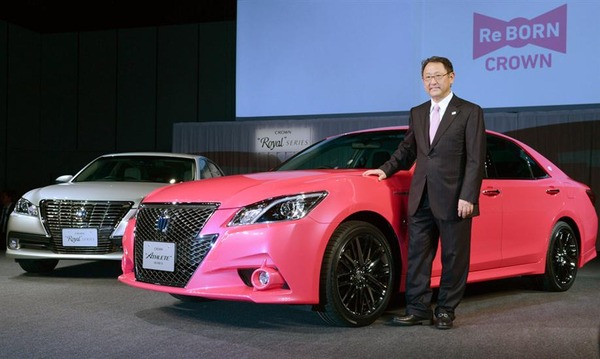
Remodeled Crown sedan launched

Remodeled Crown sedan launched


Toyota Motor Corp. on Tuesday launched a fully remodeled Crown luxury sedan in the Japanese market, featuring an all-new design and improved safety features.


By renovating its most popular sedan for the first time since 2008, Toyota aims to expand its customer base in the midst of the shrinking domestic sedan market. The automaker plans to sell 4,000 units a month of the new Crown, which is designed and developed with Japanese customers in mind.

The 14th generation Crown is available with a gasoline engine or with a newly developed hybrid system. Production of hybrid models will start from late January, the automaker said.

The new vehicle is equipped with improved safety technology to help avoid crashes, as well as a system that automatically applies the brakes in the event of pedal misapplication in a parking space.

Since its debut in 1955, the Crown has developed a reputation as one of the top-selling luxury cars in Japan over more than half a century. Toyota had sold a total of around 5.18 million units of the Crown series as of the end of November, it said.

Mazda leads diesel comeback as dirty-clunker stigma fades


Mazda leads diesel comeback as dirty-clunker stigma fades

U.S. diesel vehicle sales expected to triple by 2018

2014 Mazda6
A Skyactiv-D 2.2-liter diesel engine will be available on the Mazda6 in the second half of 2013 -- making Mazda the first Japanese automaker to market a diesel model in the United States.

From Automotive News, December 15, 2012 


(Bloomberg) -- Thirteen years after Tokyo's governor killed Japanese interest in diesel cars by barring many of them from his city, the technology is making a comeback as manufacturers adopt innovations that improve its sooty image.
Mazda Motor Corp. is betting big on cleaner diesels, creating a challenge to imports and hybrids as government incentives spur demand for fuel-efficient vehicles.
The new cars compete with SUVs from Nissan Motor Co. and Mitsubishi Motor Corp. and models that BMW and Daimler ship from Europe, where half of new cars use the engine and most automakers -- including the Japanese -- offer diesels.
Improved filters, turbochargers and fuel injection have helped make the motors quieter and cleaner than in 1999, when Gov. Shintaro Ishihara waved a bottle of black soot at reporters as he campaigned to bar them from Tokyo streets.
"I remember the diesel car I used in driving school 22 years ago -- a noisy, dirty one that produced smoke and soot," said Atsuo Ito, a 39-year-old advertising executive who bought a new Mazda Diesel CX-5 crossover. "This car is quiet, clean, and most important, it cut my monthly fuel expense by half."
'Brisk demand'
The national government this year introduced subsidies of as much as 180,000 yen ($2,200) for diesels. By 2020, the government wants 5 percent of new passenger vehicles to use the technology, up from 0.4 percent last year. As of October, sales of diesels had tripled from last year to 31,425 units in Japan, according to the Japan Automotive Dealers Association.
"The idea younger people have of diesel cars is quite different from the elder generation, who were influenced by Ishihara," said Yoshiaki Kawano, an analyst with IHS Automotive in Tokyo. "Their impression is that the cars are environmentally friendly and popular in Europe."
Mazda said 80 percent of orders for its CX-5 sport utility vehicle and Mazda6 sedan in Japan this year are powered by diesel engines even though they cost about 20 percent more than comparable gasoline versions. A diesel CX-5 gets 18.6 kilometers per liter (43.7 miles per gallon based on Japanese standards), 16 percent more than the comparable gasoline version, according to Mazda.
"We have been surprised to see such brisk demand," Mazda President Takashi Yamanouchi said last month. Customers are "convinced that they want diesels."
Global sales of diesel cars will rise 66 percent between 2010 and 2018, to 22 million, making up about 18 percent of total vehicle deliveries in 2018, according to LMC Automotive. Growth will come mainly from North America, Eastern Europe and Asia, while diesel's share in Western Europe will decline due to regulatory standards and market saturation in some countries, the researcher said.
American renaissance
Diesel engines can be more efficient because the fuel burns at a higher temperature than gasoline. But diesel's higher energy density means it can also emit more soot. In recent years, manufacturers have improved catalytic converters to burn soot and have added filters to capture more of the emissions.
Reviving the engine in Japan may help the nation's automakers break into the U.S. LMC Automotive expects diesel sales there to more than triple to 1.3 million in 2018 from 408,344 last year as stricter federal fuel efficiency standards are phased in starting in 2017.
"Clean diesel cars and light-duty trucks are in the early stages of a renaissance in America," said Allen Schaeffer, Executive Director of Diesel Technology Forum, an industry group whose members include car and component makers.
Biggest commitment
The diesel Mazda6 will be introduced in the U.S. next year. That will make Mazda the first Asian carmaker to sell a passenger car using the engine in the American market, where European makers such as Volkswagen AG set the pace.
"If the Mazda6 is priced below the Passat TDI and has great fuel economy, it can be a hit," said Mike Omotoso, senior manager of global powertrain research at LMC Automotive in suburban Detroit.
Mazda, which this year ended 45 years of rotary engine production, is making the biggest commitment to diesel among its Japanese rivals. It has increased advertising and is pairing the CX-5 and Mazda6 with its SkyActiv, an umbrella term for technologies that help it comply with stricter emission standards such as lighter vehicle bodies.
The company "has spent hugely on TV commercials and advertising to raise people's awareness and change the public image," said Masahiro Fukuda, an analyst with Fourin Inc. in Nagoya, Japan.
In the revamped models' first year on the market, Mazda expects worldwide sales of 240,000 for the Mazda6 and 190,000 for the CX-5. The company doesn't release separate forecasts for diesel sales.
Tokyo ban
Japanese diesel vehicle sales peaked in the 1980s, accounting for as much as 6 percent of new car deliveries, according to the transport ministry. In 2003, Tokyo started requiring diesel owners to install exhaust gas purifiers and barred those that didn't from driving their cars in the city. In 2001, Japanese carmakers produced 24 diesel models. By the end of 2007, there were none made at home.
Nissan was the first Japanese carmaker to reintroduce diesel into the nation's passenger market with the X-Trail SUV in 2008. Mitsubishi followed with a diesel variant of its Pajero. Last year, the two were the only diesel cars produced by domestic carmakers for their home market.
Toyota, the world leader in hybrids, agreed last year to use diesel engines supplied from BMW starting in 2014 to expand its European lineup. The carmaker offers no diesel cars in Japan.
Different smell
BMW, which ended a two-decade hiatus on diesel imports to Japan this year, says it's bringing six models to the country. Mercedes in 2010 became the first foreign producer to reintroduce diesel cars in Japan and now says it has three vehicles in the market.
Ishihara, who resigned as Tokyo governor in October and is running in the Dec. 16 lower house national election, changed his opinion of diesels after a trip to Europe.
"I found cars on the roads were almost all diesel-powered, but the smell was completely different from what we used to have in Japan," the former governor said at a press conference in March. "Diesel cars will make a comeback in Japan, which is a good thing."

Thursday, 20 December 2012

Japanese cars coming from U.S.

Japanese cars coming from U.S.

Based on article from KoreaJoongangDaily December 2012
Imports get break on import duties, but none of the models run on diesel


Japanese automakers are importing more American-made models to take advantage of the U.S.-Korea free trade agreement.

But they don’t have models that run on diesel, the new hot trend in Korea.

In October, Nissan started importing the Altima from a Tennessee plant.

On Nov. 30, No. 3 Japanese automaker Honda introduced the Odyssey and the Pilot made in its plant in Alabama. Last Wednesday, the company introduced the new Accord and Crosstour are made in a plant in Marysville, Ohio.

Japanese automakers said one reason they bring U.S. models to Korea is that they want to avoid the high-yen situation and get the benefit from the Korea-U.S. free trade agreement which went effect this year.

From March 15, the tax imposed on automobiles imported from the U.S. was halved from the previous 8 percent. The tariff will be completely abolished from 2016, according to the Korus FTA.

Cars imported from Japan are subject to an 8 percent duty.