Showing posts with label Twitter. Show all posts

Friday, 6 December 2013

Acura does Snapchat

Acura is one of the many brands that reveal their Snapchat accounts via Twitter, where Acura has already accumulated a fan base. The luxury division of the Honda Motor Company introduced its new NSX Prototype in a six-second clip to the first 100 people who added the brand on Snapchat.


Wednesday, 2 October 2013

Honda Warns Snack Brands on Twitter About the Odyseey's In-Car Vacuum Cleaner

http://www.adweek.com/adfreak/honda-warns-snack-brands-twitter-about-odysseys-car-vacuum-cleaner-152830

Perhaps you've seen RPA's new TV spots for the Honda Odyssey, which has the world's first in-car vacuum cleaner. The ads, voiced by Neil Patrick Harris and Rainn Wilson, feature junk on the minivan's floor—crayons, candy, lint balls, tiny toys—chatting obliviously before getting sucked up by the vacuum.
On Tuesday, RPA launched a social element, in which @Honda is tweeting at snack and toy brands, warning them about what's in store if they fall on the floor of an Odyssey. The idea is fun, and the tweets are generally decent—but the added bonus is that many of the brands are responding or retweeting, extending the reach of the communications beyond Honda's 176,000 followers. Well, OK, there have been snarky replies, too.

Check out some of the tweets below, along with the TV spots.


Thursday, 19 September 2013


Thursday, 12 September 2013

Volvo: Don't Panic

Volvo wanted to promote their automatic breaking system so they started following the most influential Belgian people directly on Twitter. Agency: BBDO Belgium.

Audi South Africa: #AudiA3Exchange


In the first half of 2013, an 18-wheeler truck drove across South Africa, guided by the tweets of hopeful South Africans. Inside the truck: a new Audi A3 Sportback. Outside: a social media frenzy. The Idea: Audi A3 Exchange. An opportunity for people to exchange their own car for the new Audi A3 that was inside the truck.
The campaign launched with TV, radio, online and the truck itself, all sending people to our microsite or mobi-site. Here people could enter, choose their Exchange City and monitor the truckâs progress in real time. Agency: Ogilvy & Mather Cape Town

After 3 weeks, more than 50 000 tweets guided the Exchange Truck to its final destination â Joâburg. Three finalists were put through a series of challenges. Each challenge was designed to demonstrate a feature of the new A3. The finalist who completed all four challenges in the fastest time got to exchange their car for the new Audi A3 Sportback.

Over the 3 week campaign period, 11 310 people entered to exchange their own car. The campaign generated over 50 437 tweets and Audi South Africa was trending on Twitter within 5 hours of the campaign going live. Audi South Africa increased their Twitter following by 68% in 3 weeks and generated R3 116 654 worth of earned media. And, most importantly, the interest in the A3 Sportback on the Audi website tripled, resulting in more than 100 real life test drives per week.


Tuesday, 10 September 2013

GM’s Michael Savoni on Why You Need a Customer Service Twitter Handle


Communities have changed a lot in the past few years, having manifested online in ways no one could have previously imagined. Still, some things have stayed the same. Social networks allow people to broadcast their views much the way they do in person, but often with much greater reach. Much of the time those opinions are positive, is your brand ready to respond when they’re less than complimentary?
As more companies are realizing, online conversations are varied and complex. While this fact is daunting, it also points to a great opportunity: To join conversations and provide value to customers who are asking for it, and even those who aren’t.
One of the best ways to join these conversations is to create a Twitter handle dedicated to serving customer needs that is separate from your business’ main account. Not only does this approach prevent dilution of brand messaging on your main account, it also gives you a way to provide meaningful content and tips from a valid source. It’s the same reason most companies have dedicated customer service numbers.
We think one of the brands doing this right is GM, so we chatted with Michael Savoni, the company’s social media business process lead. In his combined customer service, marketing and PR role, he oversees the @GMCustomerSVC,@ChevyCustCare, @BuickCustCare, @GMCCustCare, and @CadillacCustSVCaccounts from headquarters in Detroit, MI. Here are his tips for maintaining a strong customer service Twitter handle.

Jump in First

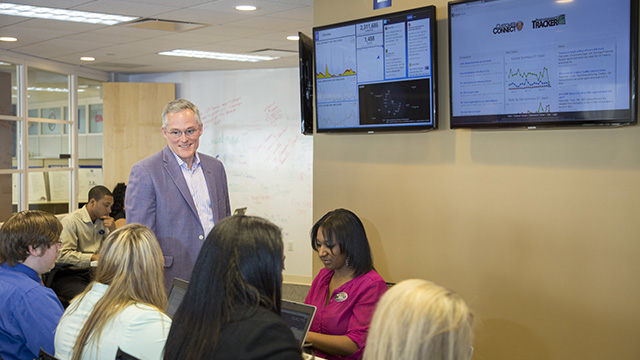
According to Savoni, customer service on Twitter is as much about listening to existing conversations as it is about reaching out yourself. In GM’s command center, social media agents track social chatter across numerous screens, where they follow everything from specific brand mentions to tweets about searching for a new car.
When someone reaches out for advice or with concerns, agents respond with an answer or suggestions to resolve the problem. But simply responding to customer concerns is not enough. Savoni encourages reaching out to people on Twitter before they ask for help.
“We don’t want to just be a robotic team responding to people who have issues. We want to be out there and help them,” he says. Recently, GM expanded its social media team with 15 new hires, whose job it is to jump in when an individual on Twitter expresses a request or concern that can be addressed by the brand.
“We hired these 15 new social media agents who are out there building relationships with our customers so that from a pre-sale and post-sale perspective, our customers know that they can go to them,” Savoni says. “From the pre-sale side, somebody may just say, ‘Hey, I’m heading to the dealership tomorrow. I’m excited to look for a new car,’ and our team is out there to say ‘Is there anything I can help you with?’”

Be What You Are: Human

While different brands have unique voices, when it comes to customer service on Twitter, putting forth a friendly, helpful persona is essential. GM did this by taking its five best call center representatives and training them to respond to customer concerns online back when it created its dedicated accounts in 2009. Today, three of those original five oversee GM’s Customer Care team.
The lesson here is to look for people who are comfortable creating a professional yet approachable rapport with customers in person or on the phone—odds are that personality will translate well online, too. Savoni describes those call center representatives as professional, playful and understanding. In an industry where issues such as safety and recalls are serious concerns, it turns out that the majority of the 700 monthly customer care conversations focus on less serious issues.
“In a typical customer case, the customer is not coming with a major problem, they’re just looking for something that they can get a little bit of help with. From a pre-sale perspective, it is a very fun conversation,” Savoni says. “We want our agents to get in there and have a little fun with them.”
To take the human touch to another level, GM Customer Care agents sign tweets with their initials to indicate who has responded to each query. Plus, Savoni says each of the backgrounds on the company’s Twitter pages will soon include photos of the social media agents, as well as their personal handles to show that they really are human.

Coordinate, Coordinate, Coordinate

At GM, the social media team members are assigned to different initiatives, such as Marketing, PR and, of course, Customer Care. Those teams engage in more than 70,000 conversations per month on Twitter, Facebook and online forums. With such a high volume of interactions, it is essential for each leg of GM’s self-proclaimed “three-legged stool” to be aware of the others’ actions.
This is especially important in times of crisis, such as recalls, or during key marketing campaigns. “When Marketing and PR are launching new vehicles or building out programs that maybe have a large social component to them, it’s important to keep our social customer care team involved. That’s going to drive a lot of conversations and traffic that could potentially stem some opportunities for our Customer Care team to get involved pre-sale or post-sale,” Savoni says.
Customer service is all about answering questions, so when your company is pushing new information into the world, it’s important to keep track of the questions it may create. With regular meetings bringing together all these teams, your customer service agents will be aware of new information before it gets to the public, allowing them to be ready for whatever may come.
When it comes to serving customers, Twitter is a fast and easy way to respond efficiently to consumer concerns. What’s important, though, is to treat managing your online customer service strategy the same way you would a phone strategy. By creating relationships based on helpful, earnest conversations, a customer service Twitter handle can help your brand show your customers you really care.
[Image credits: GM]
http://sproutsocial.com/insights/2013/05/customer-service-twitter-handle/

Friday, 2 August 2013

Twitter on Ad Retargeting Bandwagon

 
Taking a page from Facebook FB +1.87%, Twitter said it will start experimenting with using people’s Web behavior to tailor ads on the short-messaging service.
Twitter in a blog post Wednesday said that a florist could opt to use data on who visits its website to target ads to those people when they are using Twitter. The San Francisco company also said the florist could take a list of his email subscribers and pitch ads to those people if and when they are on Twitter.
This ad targeting is similar to two types of Facebook ad formats, known as FBX and Custom Audiences, respectively.
Facebook and now Twitter are taking more advertising cues from old-school Web sites such as Yahoo YHOO -0.46%, which long have tracked users across the Web for ad purposes. For example, they would use data about a user’s visit to a Chevy website to show that person Chevy ads when they surf elsewhere. Facebook started offering the so-called retargeting ads recently, and advertisers have embraced it in a big way.
The retargeting efforts muddy the original advertising philosophy of Facebook, Twitter and other social media services. The promise was that ads tailored to “social signals” — checking into a Mexican restaurant on Foursquare, or “liking” a Nike NKE +4.85% shoe on Facebook — helps generate better ads than traditional digital banner ads. But Facebook’s and Twitter’s embrace of ads based on prior website visits and email lists may be a sign that new digital ad models will mix in plenty of elements from old ad models.
Kevin Weil, a Twitter ad-product executive, said that the company continues to back new kinds of ad models based on what people tweet, the types of accounts users “follow” and other social signals. But he said it also makes sense to meld in established digital-ad techniques like retargeting when it results in a more useful ad. 
Twitter said it is starting slowly with its new ad efforts, and testing it first only in the U.S. with a small number of advertisers. The company said it may expand those new ad features if they prove popular with users and advertisers.
Consumer advocates have raised concerns about privacy implications as more digital services leverage more Web behavior and data to target ads. In its blog post, Twitter touted its privacy-friendly features, such as the ability for users to check a single box to opt out of allowing advertisers to tap their information to tailor ads on Twitter. Those people will continue to see ads on Twitter, however.
In a blog post, digital-privacy organization Electronic Frontier Foundation praised Twitter for its user-privacy features in advertising.

Thursday, 25 July 2013

How Chevy’s Corvette Stingray scored 87M impressions and 5M video views via Twitter and YouTube

How Chevy’s Corvette Stingray scored 87M impressions and 5M video views via Twitter and YouTube
Chevrolette
You knew the launch of the first Corvette to bear the Stingray badge of honor since 1976 would be a big deal in social media. The Corvette, after all, is America’s iconic, beautiful, and above all powerful sports car.
But our ADHD-fueled social media attention spans are notoriously short.
So how do you drive 87 million social media impressions over extended weeks and months? With a detailed plan, Chevy’s director of  digital Andrew Dinsdale told me last week.
And, apparently, with a lot of mystery.
14corvette-gallery-full-16
“Initially, we revealed just the crossed flags … we didn’t a show a thing of the car except some teases and a camouflaged test drive,” Dinsdale told me in his strong English accent. “We achieved the highest virality we’ve ever seen.”
That is, of course, the glory of working on a project like this. Everyone who cares about cars, or at least sports cars, is interested in the new Corvette. It’s a classic car with great heritage, and the upcoming 2014 version is lighter, faster, sexier — designed to compete with top-of-the-line European sports cars — and even gets better fuel mileage.
So on the one hand, social media for the Stingray was the easiest job ever.
“We could have done the worst plan possible and still won a lot of attention … this is an easy car to create buzz around,” Chevy’s digital director, Andrew Dinsdale, told me. “But if you want to make it last and take full advantage of the buzz you get, you have to have the people in place … and content.”
stingrayBut taking the typical one-day or weekend social splash and spreading it over months requires planning and hard work, Paul Gazda of iProspect says. iProspect, which was the agency Chevy chose for the launch, created a five-stage reveal stretching from November to December that drove 87 million Twitter impressions, five million video views, achieved a massive Twitter engagement rate of 57 percent, and drove Chevy to AdAge’s No. 1 trending brand.
That includes 170,000 people watching a livestream of the Detroit reveal in mid-January — on the same night as the Golden Globes, a NFL playoff game, and news breaking about the NHL strike ending. All that with a budget just a fraction of what Chevy typically spends on a car launch campaign.
“We never share what we spend,” Dinsdale says. “But compared to the Silverado reveal this week, which we did all-out with TV advertising, it’s one-fifteenth as much, all told. It’s relatively a cheap date … it’s about being very effective.”
The most effective piece, Dinsdale says, was a YouTube homepage takeover, which drove massive video views and also Chevy’s best-ever click-through rate back to Chevy.com. And on Super Bowl Sunday, Chevy paid a flat fee for the “first watch” skippable ads on YouTube, which most people typically click through after five seconds.
“But people didn’t skip this one,” Dinsdale told me. “Not even a real ad … we had millions of views.”
Screen Shot 2013-07-22 at 11.27.00 AM
Just because it was social, however, and about a very hot sports car, the campaign wasn’t free. The plan definitely included paid media to kickstart, to amplify, and to extend the conversation. That included the homepage takeover on YouTube, a promoted trend on Twitter, a promoted tweet, and Chevy’s Twitter account being promoted as well. In addition, iProspect seeded key YouTube videos with audiences who are interested in cars as well as with bloggers.
“You can build the greatest content and put it online, but unless you make people aware of it, it doesn’t get noticed,” Dinsdale says. “You pay to get the initial impression, and you hope people are engaged enough to stay and watch and share.”
It’s also about preparation.
For a time after the launch, Stingray was the fifth-trending search on Google, and millions of people were clicking through to Chevy’s website, interested in learning more, seeing more — and in some cases, signing up to buy one.
“We built this massive awareness, and then when people were looking, we were there with the right content,” Dinsdale said. “People are so voracious for this content, they’re clicking around to see this car.”
14corvette-gallery-full-15
I wondered aloud how all this social chatter turned into sales.
“That’s not a business problem,” Dinsdale said confidently. “People put their orders in … at the airport just recently I met a young guy who said, ‘I’m No. 19 in line.’  Our problem is not this year – our challenge is next year. These people we touched in January or February … how are we going to back to them next year?”
But that, of course, is a problem for the 2015 model.

Read more at http://venturebeat.com/2013/07/22/how-chevys-corvette-stingray-social-media-campaign-scored-87m-impressions-5m-video-views-and-7-7m-searches/#SxiOmpbxmJlbuAbe.99 

Monday, 20 May 2013


New UK study: Tweets influence brand consideration and offline actions by prospective car-buyers

Posted by Twitter. Wednesday, May 15, 2013

Many prospective car buyers engage in auto-related conversations on Twitter to seek information and listen to others’ experiences. To understand how Twitter helps automobile manufacturers connect with their potential customers, we partnered with Compete (@Compete) and looked at how Tweets from auto manufacturers influence the U.K. shoppers who see them. 

The “Tweets in Action: Auto” study found that exposure to Tweets influences prospective car-buyers’ brand consideration and likelihood to follow up offline. In other words, the more Tweets they see, the higher the likelihood that they will search for auto brands and pursue offline activities such as sign up for a test drive or look for a car dealership.

Study background & methodology

The study analyzed nearly 1,800 users and their site visitation behavior in the United Kingdom. The study looked at three different groups of users. The first group consisted of those users who were exposed to at least one Tweet (promoted or organic) by an auto brand. The two remaining groups of users were control groups: one consisted of Twitter visitors who were not exposed to auto brand Tweets, and the other represented the average internet user.

Key findings on Tweet exposure 

1. Tweet exposure corresponds to higher brand site traffic.

Compete found that Twitter users exposed to auto brand Tweets are 74% more likely to visit auto brand websites than the average internet users.


2. Tweets influence brand awareness and consideration for auto manufacturers.

More than one-third of Twitter users who see auto brand Tweets search for auto manufacturers, which is 54% higher than the average internet users.


3. Exposure to Tweets influences the likelihood of conversion

Compared to the average internet users, Twitter users exposed to Tweets from auto brands are nearly twice as likely to engage in lower-funnel activities, such as sign up for a test drive and locate a dealership.


The exposure to Tweets helps drive consideration and conversion for auto manufacturers - the higher the frequency of exposure, the higher the likelihood to take offline, lower-funnel actions. Twitter users expose to Tweets are more likely than the average internet users to visit brand sites, search for brands and take lower-funnel actions.