Showing posts with label Porsche. Show all posts

Monday, 17 March 2014

Porsche looks to augmented reality for immersive Panamera experience

By 


Consumer using Porsche Panamera app
German automaker Porsche is equipping dealers with an augmented reality iPad application for the Porsche Panamera that immerses interested consumers in the vehicle’s capabilities.
When hovering the iPad over a vehicle, the app synchronizes with markers that lead to stills, text, video and animation to give consumers a full sense of what the vehicle offers. The app coincided with the release of the Panamera in the Middle East, aiming to increase exposure in eight countries.
“The Porsche Panemera app integrates with a  sophisticated brand experience environment within the dealerships,” said Steve Blyth, founder and managing director of Engage Productions, London.
“The latest digital content from Porsche is displayed on tablets, screens, and the Augmented Reality devices,” he said. “It’s a holistic deployment pushing the latest novel features of the new Panemera car in partnership with a consistent and refined sales message.
“Having launched across 8 countries in the Middle East, the app has created more activity, footfall and customer interactions in store prompting more test drives and sales conversations with customers and has invigorated Porsche sales associates with a new sales tool to engage their customers.”
Porsche enlisted Engage Production to create the app.
Discover and exploreThe app is designed for consumers to use independently in dealerships or with the assistance of an employee.
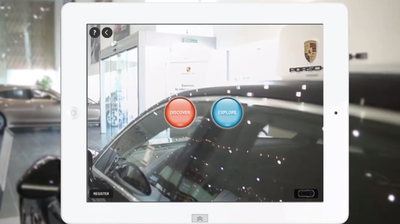
Porsche Panamera augmented reality app
From a short distance, consumers can move the iPad screen over different parts of the Panamera to activate a variety of triggers.
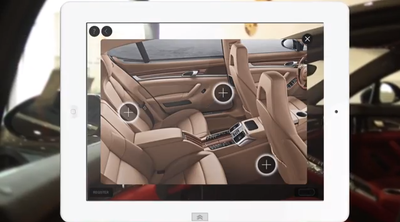
Porsche Panamera augmented reality app
Consumers can then tap on any trigger that appeals to them for interactive content. Information about the technical aspects of the car such as speed, aerodynamics and color are juxtaposed with lifestyle content.
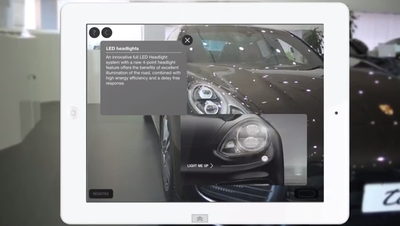
Porsche Panamera augmented reality app
The sales team will likely be able to better communicate why the Panamera is an ideal car. Rather than pulling out sheets of paper or maneuvering the vehicle itself, the sales team will be able to quickly navigate the app for relevant information.
Plus, by having a comprehensive guide on hand, employees will have more angles to approach the potential sale with.
Engage Production produced a video to show the app in action.


Porsche Panamera augmented reality app
Early stagesAs the name suggests, augmented reality technology has a seemingly infinite number of uses. Some luxury brands have begun experimenting with a few rudimentary forms.
For instance, German automaker Audi teamed up with Metaio to create an augmented reality mobile application that can recognize and expound upon more than 300 elements of the A3 model to allow for a deeper and accessible understanding of the vehicle.
The A3 eKurzinfo app identifies facets of the A3 vehicle from the windshield wiper’s insignia to engine components and gives how-to information or virtual maintenance tutorials. Providing consumers with an in-depth and responsive app is likely to promote positive, brand experience (see story).
Also, The Ritz-Carlton animated its print advertisements with augmented reality in the female Pan Arab magazine Sayidaty, which marks the first campaign of its kind for the brand in the Middle East.
Through the help of technology from augmented reality brand Blippar, readers of Sayidaty are able to scan Ritz-Carlton ads or articles for a three-dimensional experience. The hotel chain’s ability to reach women consumers on a more engaging level will likely secure interest in what is still a nascent market (see story).
While augmented reality has not yet become a vital part of marketing, brands that adopt the technology exude a pioneering spirit that may be appreciated by consumers.
“Augmented reality apps are not essential for auto showrooms,” said Simon Buckingham, CEO of Appitalism, New York.  ”When the consumer is in the showroom, the dealer staff would like to interact with them directly.
“The interactive info may distract the consumer and disrupt the purchase process,” he said.
“However, consumers could like to use that app funtionality outside of the showroom and may prefer to get their data efficiently via the app than when on the showroom.
“This new app from Porsche gives consumers another way to get information about cars in a cool new way.”

Tuesday, 4 February 2014

Everyone can own a Porsche

December 21, 2013 by Adverblog

Today, everyone can own a Porsche. Well, maybe everyone with a 3D printer. To promote its Cayman S model, Porsche offers car lovers 3D printing data for this model, so those who actually own a 3D printer can customize, play with it and share it with hashtage #3DCayman. Ah, the games for the rich!

Check out the video here: https://www.youtube.com/watch?v=1aJ48gCblHQ

Wednesday, 25 September 2013

Print Ads Just Can't Keep Up With the Porsche 911
http://www.adweek.com/adfreak/print-ads-just-cant-keep-porsche-911-152700
Here's a nice, fun, simple campaign for Porsche China by the Shanghai office of Fred & Farid. And kudos to the client for agreeing to lose the beauty shots of the vehicle almost entirely. Three more ads plus credits below.


Wednesday, 20 March 2013


How electricity lost its spark

Toby Hagon
Published: March 16, 2013 - 9:08AM


Volkswagen XL1 at the 2013 Geneva motor show.

In taking the wraps off the game-changing Chevrolet Volt hybrid in 2008, then General Motors boss Rick Wagoner said the much-hyped car was about reducing motoring's reliance on oil.

''A great way to open our second century,'' was his introduction to a car claimed to cost less to run daily than a cup of coffee.

The Volt - which went on sale in Australia with a Holden badge last year - was the first petrol-electric car to have batteries that could be recharged from a household power point. Sales have been slow, as predicted, mainly because the Volt's $60,000 price tag is about $20,000 above similar petrol-powered cars.

The thinking behind plug-in hybrid vehicles makes sense. Most people drive short distances daily and would be happy to use electricity, rather than fuel. But for longer distances, a traditional engine can recharge the batteries or help power the car, extending the range of the PHV or PHEV (for plug-in hybrid or plug-in hybrid electric vehicle, depending on who's concocting the acronym) to that of a normal petrol-powered car.

The technology is becoming widely accepted as the way forward for hybrids, with most manufacturers following GM's lead.

It also threatens the future of pure electric vehicles, as GM's Volt has comfortably outsold the all-electric Nissan Leaf and Mitsubishi i-MiEV in the US.

The first clue that the Volt was a landmark vehicle was the peering over the fence by rival Toyota.

The clear leader in hybrid technology - and the company that in the late 1990s swam against a fuel-rich tide as other manufacturers mocked its then quirky petrol-electric technology - was quick to respond with a plug-in version of its Prius. Others are following suit. Mitsubishi will begin selling a plug-in version of its Outlander soft-roader in Australia later this year.

Volvo, too, was quick to offer a plug-in hybrid - the world's first with a diesel engine - in the form of a V60 that's sold overseas.

Last week's Geneva motor show revealed a rush of new plug-in hybrid machines, with the giant Volkswagen Group also entering the fray. Its quirky XL1 two-seater (see breakout) is an experiment on wheels, teaming a two-cylinder diesel with a lightweight carbon-fibre body and rechargeable batteries to use a claimed 0.9 litres per 100 kilometres.

Other Volkswagen brands, including Porsche, will soon reveal production plug-in vehicles, while Audi is racing down the plug-in hybrid path with its e-Tron models. An e-Tron version of the A3 could be on sale in Australia in 2014.

In Geneva, Audi technical development executive, Dr Wolfgang Durheimer, reinforced the company's vision for plug-in hybrids. ''Our clear policy is plug-in hybrids,'' Durheimer says. ''I'm absolutely convinced that plug-in hybrid technology will be more than just a bridging technology - it will be the answer for the time being in the premium end of the luxury segment.

''Why? Because plug-in hybrids give you the advantages of both electrical and combustion engines, and at the same time, do not carry over the major disadvantages of the individual technologies. That means you can go from completely emission-free in the city limits … cover long distances without any problems and again reach your final destination when you recharge your batteries.''

Durheimer says plug-in hybrid vehicles have broader applications.

''When it comes to individual transportation, I think plug-in hybrids are the solution until we develop batteries with much higher density of energy and much lower weight. These are the limiting factors for the breakthrough of pure electric technology right now.''

The rush to plug-in hybrid technology is also no doubt in response to poor take-up of electric vehicles. After being the starring act for several years, the electric car backed into the shadows in Geneva this year as car makers grow weary of waiting for sales to take off. Electric vehicles were not completely absent from the stands, but no new models were unveiled and car company executives barely mentioned them.

''Public confidence (in electric) has really fallen since its peak at the Paris show in 2010, when we only talked electric,'' BIPE analyst Clement Dupont-Roc told AFP.

Back then, French car maker Renault opened the order books for its first electric models and chief executive Carlos Ghosn said he expected the cars to represent 10 per cent of the market by 2020.

Renault's compatriot PSA also plunged into the space, as did Japan's Nissan with its Leaf.

But as things stand, sales have fallen far short of expectations.

In France, which claims to be the leading market in Europe for electric cars, fewer than 6000 new such vehicles were registered last year. In Australia, the number was only 173, or less than 0.02 per cent of the market; Porsche sold almost eight times as many cars.

The low volumes are part of the explanation for the weak offering in Geneva, but there are other issues.

''There are three tasks we have to overcome when it comes to electric vehicles,'' the president of Japanese Mitsubishi, Osamu Masuko, told AFP at the show.

''One is pricing, second is the mileage they can cover and the third is infrastructure.''

But Audi's Durheimer says there are limited applications for pure electric vehicles.

''Full electric transportation, of course, will also be around, but from my forecast it will be mainly limited to smaller areas to cover inner-city transportation, taxis, mail, delivery transport,'' Durheimer says.

''They can go on electric mode because they pass by the same infrastructure … recharging station maybe, several times a day.''

As electric cars struggle to find a foothold, there's a renewed surge towards fuel-cell vehicles, which perform a chemical reaction to turn hydrogen into electricity.

Mercedes-Benz, Hyundai, Ford, Toyota and BMW are some of the leaders in the race to produce the first commercially viable fuel-cell car, although they remain challenged by high production costs and a lack of refuelling infrastructure.

Mercedes-Benz parent Daimler, whose hydrogen-powered car technology is the most advanced but still prohibitively expensive, will pool investment with its Japanese and US partners. The program aims to cut the cost of technology and launch the world's first fuel-cell vehicles for the mass market in 2017, the companies say.

Hyundai is also betting on fuel cells to leapfrog battery technology and showed hydrogen-powered production models at last September's Paris motor show.

As Daimler and many peers are increasingly convinced, hydrogen cars now offer ''the greatest potential for emission-free driving'', Mercedes-Benz development chief Dr Thomas Weber says.

Plug-in hybrids and fuel-cell vehicles may well be the future, but until they come down considerably in cost, more traditional hybrids continue to rule the roost. In the US last year, Chevrolet's Volt attracted 23,461 buyers. The expanding Toyota Prius family, in contrast, found its way into 236,659 homes.

with Agence France-Presse, Reuters

Thursday, 29 November 2012

In the World of Gaming: "Need for Speed" Live Action TV Ad Sexes up Various Car Models


Saturday, 20 October 2012


Has Volkswagen Reinvented the Automobile?


by Detroit Bureau on Oct.16, 2012

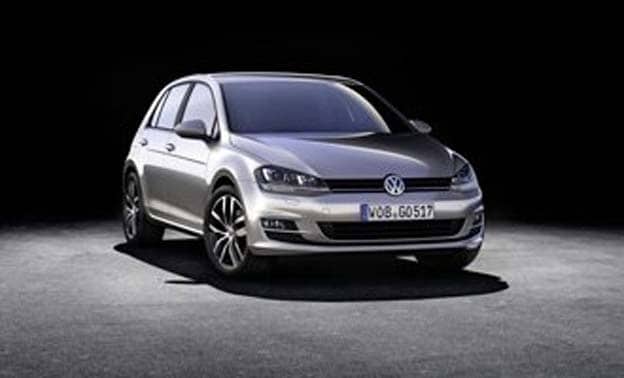
Some of the new VW Golf's biggest changes may not be readily apparent to buyers.
Every so often, a product comes along that transforms the auto industry.  Henry Ford’s Model T was one example. So was the original Volkswagen Beetle.

Despite the usual marketing hype, the third-generation Beetle that VW launched last year is far from a revolutionary breakthrough – or so it might seem at first glance.  From a designer’s view, it is a morph somewhere between the original “people’s car” and the so-called “New Beetle” of a decade back.

Yet, a closer inspection suggests that the latest iteration of the iconic coupe is far more revolutionary than might initially meet the eye.  That’s because the real breakthrough comes in the way the newest Beetle – and virtually everything else that will now be developed by the German automotive giant – is being designed and manufactured.


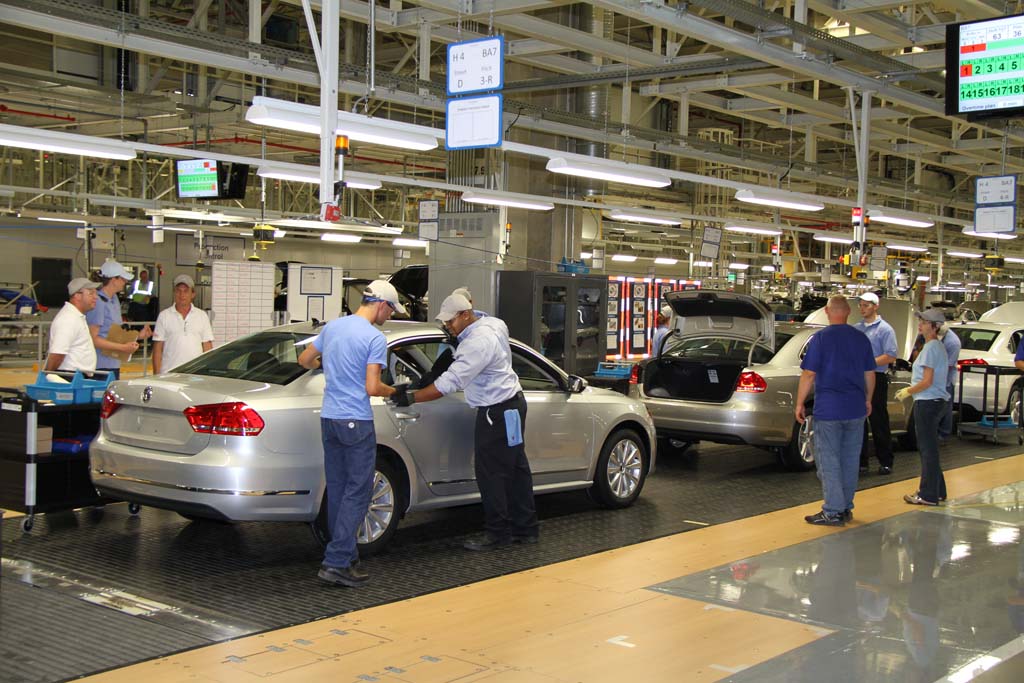
Going forward, any model using the new MQB platform -- from the little Polo to the big Passat, shown here -- could roll down the same VWAG assembly line.

If the project proves “stable,” in the words of VW’s technology czar, it could yield a 30% reduction in the cost of building the typical vehicle – while allowing the maker to add new models for surprisingly little investment – and in a fraction of the time it normally takes to bring a vehicle to market.

Once upon a time, automakers developed specific platforms – sometimes called a chassis, sometimes an architecture – for each individual vehicle.  In recent decades, makers have gotten smarter and more efficient, finding ways to share platforms among multiple products. Ford Motor Co., for example, plans to offer as many as 10 different models based on the underpinnings used for its compact Focus model, including the new 2013 C-Max “people-mover.”

Even the most flexible of these platforms usually have narrow limits as to how much flexibility they permit a maker in terms of length or width or height – or whether a vehicle can have its engine up front or in the back, or drive the front, rear or all four wheels. If Volkswagen achieves what it set out to do with a far more ambitious approach to platform development, however, many of these limits will vanish.

The maker currently offers 245 different models shared among its dozen brands and the vast majority, going forward, will share the same underpinnings found in the latest Beetle and the even newer remake of the Golf.  Codenamed MQB, this platform will act as the foundation, in fact, for a dizzying array of seemingly unrelated models – everything from the subcompact Volkswagen Polo to the midsize Passat sedan as well as the VW Tiguan and Audi Q3 crossovers.

A second platform, dubbed MLB, will serve products as diverse as the Audi A4, A6 and A8 sedans, the new Porsche Macan sport-crossover and possibly even a future Bentley, hints Dr. Ulrich Hackenberg, Volkswagen’s Board Member in Charge of Technology.  Audi, he notes, is overseeing the development of this platform which can mount its engine in either the front of the vehicle or the rear.


Even Porsche will adopt the new platform strategy.

A third platform, codenamed MSB, will handle performance machines and bigger vehicles, especially those using front engines and rear or all-wheel-drive.  No surprise, this package is the responsibility of the newest member of the 12-brand VW family, Porsche.

A final platform — known as NSF, for New Small Family — was a late addition and will focus on a new generation of microcars, such as the Volkswagen Up and perhaps even the tiny, low-cost offerings that the German maker is considering for an all-new brand specifically targeting emerging markets such as Indonesia or India.

Each platform has wide flexibility in terms of the basic size of the vehicle and the sort of powertrain technology that can be used, according to Hackenberg. Notably, one of the goals is to essentially create a computer-like plug-and-play toolkit of different powertrains so any individual VW product will be able to use an assortment of gas and diesel engines, hybrids, plug-ins, pure battery-electric drive and other technologies under development – such as a hydrogen fuel cell drive.

“The MQB platform, (for one), will allow us to potential bring any powertrain into the car,” Hackenberg explains. “It will just depend on the market” requirements.

But the biggest benefit will come from driving down product development and production costs.  On the manufacturing side, he says, “We expect, if the process is stable, to save 30% on total assembly costs,” once the new platform strategy is fully implemented.

Perhaps equally important, the engineering chief quickly adds, it that, “this is a key enabler” to produce even more niche and specialty vehicles.  That’s particularly critical in the modern automotive market where customers won’t settle for me-too products but want vehicles that meet their precise needs and desires.

Another advantage, VW believes, is that by “communizing” key elements of vehicle design that matter little to consumers it will be easier to share innovations and features – such as radar-guided Active Cruise Control, backup cameras or infotainment systems – that might otherwise be restricted to more expensive models, according to VW officials, who have dubbed the strategy “democratizing innovation.”

The new platform strategy is being paired with other engineering and manufacturing breakthroughs – such as the hot-formed steel stamping process introduced on the all-new, 2013 VW Golf. That technology helped shave significant weight off the new model while also increasing its strength and crashworthiness, Hackenberg claims.

“This is something we’re very aware of – and very concerned about,” acknowledges a senior executive involved in advanced product development at General Motors which sees Volkswagen as one of its key global competitors.  “By the time we figure it out they may have a several-year lead on us,” he confided to TheDetroitBureau.com.

“I have no doubt this is an incredibly flexible (approach) and that they’re saving lots of money,” adds Jim Hall, head of Detroit-based automotive consulting firm 2953 Analytics. And it will give the maker the flexibility to hold down product costs – if competition demands – or pass the savings onto shareholders, suggests Hall.

He cautions that VW isn’t the only global maker working to reduce development and production costs even while making its platforms more flexible. Toyota has similar goals, for one. But he says it puts VW “in the hunt” as it sets out an ambitious goal to become one of, if not the, best-selling and most profitable automaker worldwide by the end of the decade.

Friday, 5 October 2012

Revealed: World's top car brands

Published: October 4, 2012 - 10:33AM View full list 

Toyota has retained the top spot for automotive brands after being named the most valuable car marque in the world in a survey of the top 100 brands by research company Interbrand.
In the 2012 Best Global Brands top 100 list Toyota placing tenth overall, rising one place compared to 2011’s rankings. The company’s brand value was judged to be $30.3 billion, an increase of nine per cent.

The next top automotive brand was Mercedes-Benz, which also rose one spot to 11th and had its brand value increase to $30.1 billion – up 10 per cent. Fellow German luxury maker BMW jumped from 15th place in 2011 to 12th this year, with an increase of 18 per cent to a $29.1 billion brand value.


While the three highest ranking car brands all posted strong percentage gains, Nissan was the biggest improver among the car makers. It rose from 90th spot last year to 73rd in 2012, and the Japanese car maker’s brand value leaped by 30 per cent to $4.96 billion.

This year there were 12 car makers in the hunt, with fast-growing South Korean brand Kia joining the fray, jumping into the list in 87th spot. Its maiden appearance outranked Ferrari, which remained in 99th position, stable compared to its 2011 ranking.

Kia’s sister brand Hyundai continued to rise through the rankings, jumping from 61st position to 53rd, with a brand value of $7.5 billion – up 24 per cent. Ford, Volkswagen, Audi and Porsche all made gains on their 2012 positions.

Honda was the only car brand to slip down the rankings, falling from 19th last year to 21st in 2012. Its brand value dropped by 11 per cent to $17.3 billion.

The Best Global Brands list comes up with the brand rankings by looking at the financial performance of the product or service, how influential the brand is in customers’ decision making processes, and how the brand can leverage its position to make a profit, which then affords each brand a monetary value.

The results from Interbrand contradict findings published by BrandZ earlier this year which put BMW ahead of Toyota and Mercedes-Benz.

Top ranking car brands
  1. Toyota (10th overall; brand value $30.23bn; +1 position)
  2. Mercedes-Benz (11th; $30.1bn; +1 position)
  3. BMW (12th; $29.1bn; +3 positions)
  4. Honda (21st; $17.3bn; -2 positions)
  5. Volkswagen (39th; $9.3bn; +8 positions)
  6. Ford (45th; $8.0bn; +5 positions)
  7. Hyundai (53rd; $7.5bn; +8 positions)
  8. Audi (55th; $7.2bn; +4 positions)
  9. Porsche (72nd; $5.2bn; no change)
  10. Nissan (73rd; $5.0bn; +17 positions)
  11. Kia (87th; $4.1bn; new entry)
  12. Ferrari (99th; $3.8bn; no change)